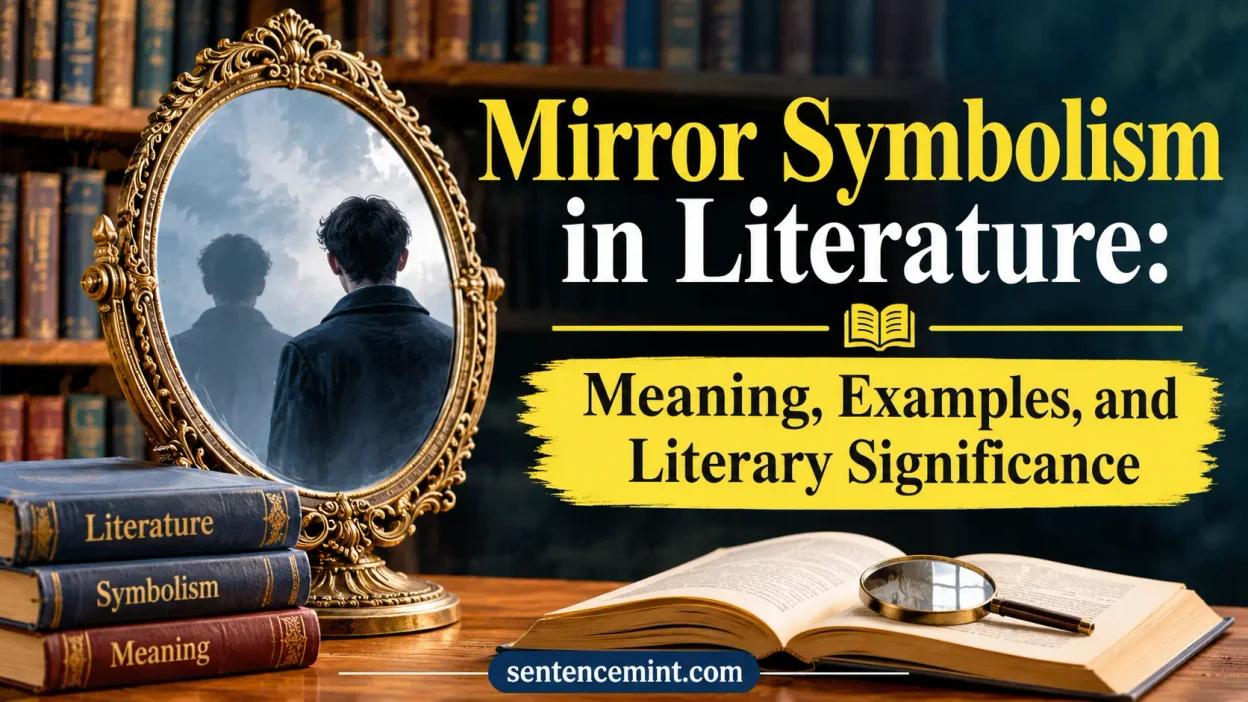
Mirrors are powerful literary symbols because they allow characters and readers to examine more than physical appearances. In literature, a mirror can represent identity, truth, self-reflection, vanity, illusion, and the hidden parts of human nature. Although a mirror appears to show an accurate image of reality, writers often use it to suggest that appearances can be misleading and that understanding oneself is more complicated than simply looking at a reflection.
From fairy tales and Gothic fiction to poetry, novels, and modern storytelling, mirrors have played an important role in exploring psychological and philosophical ideas. A character looking into a mirror may be questioning their identity, confronting an uncomfortable truth, remembering the past, or discovering something they have tried to hide.
Mirror symbolism in literature also creates opportunities to explore the difference between reality and appearance. A reflection may look familiar but can represent a different version of the self, an alternative world, or an inner conflict.
Understanding mirror symbolism helps readers recognize deeper meanings behind ordinary objects and appreciate how writers use familiar images to communicate complex emotions and ideas.
Quick Answer: What Does a Mirror Symbolize in Literature?
In literature, a mirror commonly symbolizes identity, self-reflection, truth, illusion, vanity, and the relationship between appearance and reality. It can represent a character’s search for self-understanding, an encounter with hidden emotions, or the difference between how someone sees themselves and how others perceive them. Depending on the story, a mirror may also symbolize transformation, duality, memory, deception, and psychological conflict.
TL;DR: Mirror Symbolism in Literature
- Identity: Understanding who a character really is.
- Self-reflection: Examining thoughts, feelings, and personal choices.
- Truth: Confronting realities that cannot easily be ignored.
- Illusion: Showing how appearances can deceive.
- Vanity: Excessive concern with physical beauty and admiration.
- Duality: Representing two sides of a personality or existence.
- Transformation: Signaling changes in identity or perspective.
- Psychological conflict: Revealing hidden fears and desires.
- Memory: Connecting characters with their past.
- Reality and fantasy: Creating a boundary between different worlds.
1. Mirrors as Symbols of Identity
One of the most common meanings of mirrors in literature is identity. A mirror allows characters to see their physical appearance, but writers often use this moment to explore deeper questions about who they are.
A character looking into a mirror may recognize their face while feeling disconnected from the person they see. This difference between physical recognition and emotional understanding can reveal uncertainty about identity.
For example, a character who has experienced a major life change may look at their reflection and struggle to recognize the person they have become. The mirror becomes a symbol of the distance between their former identity and their present self.
Writers may use mirrors to represent:
- The search for personal identity.
- Conflict between inner feelings and outward appearance.
- Changes in personality.
- Questions about belonging and self-worth.
- The difference between self-image and reality.
In this way, a mirror becomes more than a reflective object. It becomes a literary tool for examining the complicated relationship between appearance and identity.
2. Mirrors as Symbols of Self-Reflection
Mirrors frequently symbolize self-reflection, both literally and psychologically. When a character looks into a mirror, the action can represent an attempt to understand personal thoughts, emotions, and behavior.
In literature, self-reflection often occurs when characters face difficult decisions or question their previous actions. A mirror can emphasize the moment when someone begins examining their own choices rather than blaming other people or circumstances.
For example, a character who has acted selfishly may look into a mirror after a conflict. The reflection can represent an internal confrontation with guilt, regret, or personal responsibility.
This symbolism may communicate:
- Self-examination.
- Emotional awareness.
- Personal responsibility.
- Recognition of mistakes.
- The desire for personal growth.
A mirror can therefore represent the beginning of a character’s journey toward greater self-understanding.
3. Mirrors as Symbols of Truth and Reality
Mirrors are traditionally associated with truth because they reflect what stands before them. In literature, however, this association can become more complicated.
A mirror may reveal something a character has ignored, hidden, or refused to acknowledge. It can symbolize the moment when an uncomfortable truth becomes impossible to avoid.
For example, a character who believes they are morally superior may see their reflection and begin questioning their behavior. The mirror can represent an encounter with personal reality rather than the idealized image they have created.
Writers may use mirror imagery to explore:
- Hidden truths.
- Honest self-evaluation.
- The consequences of deception.
- The difference between belief and reality.
- Recognition of uncomfortable facts.
However, mirrors do not always represent reliable truth. Their reflections can be distorted, incomplete, or manipulated. This makes them especially useful when writers want to question whether people can ever understand reality completely.
4. Mirrors as Symbols of Illusion and Deception
Although mirrors appear to show reality, literature often uses them to explore illusion and deception.
A reflection is not the actual object or person. It is an image that depends on light, angle, and perspective. This creates an opportunity for writers to question how accurately people understand the world around them.
A mirror may represent a false impression, a misleading identity, or a world that looks familiar but operates differently.
In fantasy and psychological fiction, mirrors may reveal impossible images, alternate realities, or distorted versions of characters.
This symbolism can suggest:
- The unreliability of appearances.
- False beliefs and misunderstandings.
- Hidden motives.
- Distorted self-perception.
- The difference between imagination and reality.
By using mirrors in this way, writers remind readers that what appears true may not always represent the complete truth.
5. Mirrors as Symbols of Vanity and Physical Beauty
Mirrors are also associated with vanity because people often use them to examine their appearance. In literature, this connection can reveal characters who place excessive importance on beauty, youth, status, or admiration.
A character who repeatedly looks into a mirror may be concerned with how others perceive them. Their reflection can become a symbol of insecurity or an obsession with physical perfection.
This meaning appears in fairy tales, myths, and stories that criticize the belief that outward beauty determines personal value.
Mirror symbolism can represent:
- Pride in physical appearance.
- Fear of aging.
- Obsession with beauty.
- Insecurity and self-consciousness.
- Dependence on external approval.
Writers may use this symbolism to show how vanity can influence decisions and damage relationships.
6. Mirrors as Symbols of Duality and the Two Sides of Human Nature
A mirror creates an image that resembles the person standing before it, but the reflection is reversed. This visual relationship makes mirrors effective symbols of duality.
In literature, duality often refers to the existence of contrasting qualities within one person. A character may appear kind while hiding selfish desires, or seem confident while struggling with fear and insecurity.
A mirror can represent these opposing sides of human nature.
Common interpretations include:
- Good and evil.
- Light and darkness.
- Confidence and insecurity.
- Public identity and private personality.
- Reason and emotion.
- Conscious and unconscious desires.
In Gothic and psychological literature, mirror imagery can suggest that every person has hidden qualities that may contradict their outward personality.
The mirror becomes a visual representation of the struggle between the self people show to the world and the self they keep hidden.
7. Mirrors as Symbols of Transformation and Change
Mirrors can also represent transformation. A character who sees a changed reflection may be confronting the consequences of an important experience.
This change may be physical, emotional, psychological, or spiritual.
For example, a character who has survived a difficult event may look into a mirror and realize that their identity has changed. Their reflection becomes a reminder of everything they have experienced.
In fantasy literature, magical mirrors may even reveal a person’s possible future or show how they might look under different circumstances.
Mirror symbolism can therefore represent:
- Personal development.
- Changes in identity.
- Emotional maturity.
- The consequences of experience.
- A new understanding of life.
A mirror may also mark a turning point in a story, especially when a character begins seeing themselves or the world differently.
8. Mirrors as Symbols of Psychological Conflict
Mirrors are particularly effective in psychological and Gothic literature because they can represent the hidden mind.
A character may look into a mirror and experience fear, discomfort, or confusion. Sometimes the reflection seems unfamiliar, creating a sense that the character is disconnected from their own identity.
Writers may use these scenes to explore guilt, anxiety, repression, insecurity, and inner conflict.
For example, a character who hides a painful secret may see a reflection that seems to expose their emotional condition. The mirror becomes a symbolic space where hidden feelings emerge.
This meaning may include:
- Fear of one’s own thoughts.
- Guilt and regret.
- Repressed emotions.
- Anxiety about identity.
- Conflict between conscious and unconscious desires.
In this context, the mirror does not necessarily reveal a supernatural truth. It may simply make a character’s internal struggle visible to the reader.
9. Mirrors in Fairy Tales: The Example of Snow White
One of the most famous literary examples of mirror symbolism appears in the fairy tale Snow White.
The Evil Queen owns a magical mirror that answers her questions about who is the fairest in the kingdom. She depends on its responses to confirm her beauty and superiority.
The mirror symbolizes several ideas:
- Vanity and obsession with appearance.
- The desire for external approval.
- Truth that challenges personal pride.
- Jealousy and insecurity.
- The dangers of comparing oneself with others.
The Queen’s relationship with the mirror reveals how strongly her identity depends on being considered beautiful.
When the mirror declares that Snow White is fairer, the Queen cannot accept the answer. Her reaction demonstrates how vanity and insecurity can turn into jealousy and destructive behavior.
The mirror is therefore more than a magical object. It represents the Queen’s dependence on external validation and her inability to accept a reality that challenges her self-image.
10. Mirrors in Alice’s Adventures: The Example of Through the Looking-Glass
Lewis Carroll’s Through the Looking-Glass, and What Alice Found There (1871) uses a mirror as the gateway to a strange alternative world.
Alice passes through a looking-glass and enters a place where familiar rules appear reversed and ordinary experiences become unusual.
The mirror represents:
- An alternative version of reality.
- Imagination and fantasy.
- Reversal and contradiction.
- The relationship between familiar and unfamiliar worlds.
- Exploration and personal discovery.
The looking-glass world challenges Alice’s understanding of ordinary life. It resembles her familiar surroundings but operates according to different rules.
Carroll uses this idea to explore logic, language, identity, and the limits of ordinary perception.
The mirror becomes a boundary between two worlds, allowing readers to question whether reality is always as straightforward as it appears.
11. Mirrors in Gothic Literature
Gothic literature frequently uses mirrors to create mystery, fear, and psychological tension.
A mirror may reveal an unexpected image, reflect an empty room, or create the impression that something exists beyond ordinary reality.
These scenes can make familiar spaces feel threatening.
In Gothic storytelling, mirrors may symbolize:
- Hidden secrets.
- Supernatural mystery.
- Fear of the unknown.
- Fragmented identity.
- Psychological instability.
- The boundary between life and death.
Writers may also use old or damaged mirrors to create an atmosphere of decay and uncertainty.
A reflection that appears distorted or unfamiliar can suggest that a character’s understanding of reality is becoming unstable.
12. Mirrors as Symbols of Memory and the Past
Mirrors can also represent memory because looking at a reflection may remind characters of earlier versions of themselves.
An older character might see their younger appearance in an old photograph or remember how they once looked. A mirror can therefore become a symbol of the passage of time and the relationship between past and present identities.
This symbolism may be used to explore:
- Nostalgia.
- Regret over past decisions.
- Memories of lost relationships.
- Fear of aging.
- Changes in identity.
- The contrast between youth and experience.
A character’s reflection can remind them that time has changed their appearance, beliefs, and priorities.
In this way, mirrors can help writers explore how the past continues to influence the present.
13. Mirrors as Symbols of Social Identity and Judgment
In some literary works, mirrors can represent the pressure people experience when trying to meet society’s expectations.
A character may judge themselves according to standards of beauty, success, wealth, or social status. Their reflection can become a reminder of the difference between who they are and who they believe society expects them to be.
This symbolism can explore:
- Social pressure.
- Cultural expectations.
- Beauty standards.
- Self-worth and acceptance.
- Public image and private identity.
- Fear of judgment.
For example, a character who feels uncomfortable with their appearance may repeatedly examine their reflection because they are worried about how others perceive them.
The mirror then represents not only self-image but also the influence of society on personal identity.
14. Mirrors in Poetry and Literary Imagery
Poets often use mirrors as images of reflection, truth, memory, and time. Their visual simplicity makes them effective tools for expressing complex emotions.
A mirror may represent a person’s attempt to understand their identity, or it may become an image of emotional distance between the past and present.
One notable example is Sylvia Plath’s poem Mirror (1961). The poem presents a mirror as a reflective object that describes itself as truthful and impartial.
As the poem develops, the mirror becomes connected with a woman’s changing appearance and her struggle with aging and identity.
The poem explores:
- The relationship between appearance and identity.
- The passage of time.
- The fear of aging.
- The desire to understand oneself.
- The difference between truth and emotional acceptance.
Plath’s poem demonstrates how a simple mirror can become a complex literary voice through personification and imagery.
15. Positive and Negative Meanings of Mirrors in Literature
Mirror symbolism can carry both positive and negative meanings. Its interpretation depends on the character, setting, and events surrounding the reflection.
| Positive symbolism | Negative symbolism |
|---|---|
| Self-awareness | Obsession with appearance |
| Truth and honesty | Distorted reality |
| Personal growth | Insecurity |
| Understanding identity | Identity confusion |
| Reflection and wisdom | Vanity and pride |
| Transformation | Fear of change |
| Recognition of mistakes | Guilt and regret |
| Clarity | Deception and illusion |
This contrast makes mirrors especially valuable in literature. They can represent the possibility of understanding oneself while also revealing the dangers of becoming trapped by appearances.
16. How Writers Use Mirror Symbolism
Writers use mirrors in several ways to develop characters, communicate themes, and create meaningful imagery.
A mirror scene may reveal a character’s emotional condition without requiring a long explanation. It can also introduce mystery, create suspense, or suggest a change in perspective.
Common literary techniques include:
- Symbolism: Using a mirror to represent identity, truth, or illusion.
- Personification: Giving a mirror human qualities, as Sylvia Plath does in Mirror.
- Foreshadowing: Using an unusual reflection to suggest future events.
- Imagery: Describing reflections to create emotional or visual effects.
- Contrast: Showing the difference between a character’s appearance and inner personality.
- Metaphor: Comparing self-examination to looking into a mirror.
- Setting: Using mirrors in Gothic spaces to create mystery and suspense.
These techniques allow writers to turn an everyday object into a meaningful part of a story’s deeper message.
Frequently Asked Questions About Mirror Symbolism in Literature
1. What does a mirror symbolize in literature?
A mirror commonly symbolizes identity, self-reflection, truth, illusion, vanity, and the relationship between appearance and reality. Writers use mirrors to reveal characters’ thoughts, emotions, and hidden personalities.
2. Why are mirrors used as symbols of identity?
Mirrors show a person’s physical reflection, making them natural symbols of self-image and identity. In literature, looking into a mirror may represent questioning who someone is or recognizing changes in their personality.
3. What does a broken mirror symbolize in literature?
A broken mirror may symbolize a damaged identity, emotional conflict, shattered beliefs, separation, or a distorted understanding of reality. Its meaning depends on the context of the story.
4. What does the mirror symbolize in Snow White?
In Snow White, the magical mirror symbolizes truth, vanity, jealousy, and the desire for external approval. It reveals the Evil Queen’s obsession with beauty and her inability to accept being surpassed.
5. What does the mirror symbolize in Through the Looking-Glass?
In Lewis Carroll’s Through the Looking-Glass, the mirror represents an alternative reality where familiar rules are reversed. It symbolizes imagination, fantasy, exploration, and the relationship between reality and illusion.
6. What does a mirror symbolize in Gothic literature?
In Gothic literature, mirrors often symbolize mystery, hidden secrets, psychological conflict, supernatural possibilities, and fragmented identity. They can also create fear by showing distorted or unexpected reflections.
7. What does a mirror symbolize in Sylvia Plath’s poem Mirror?
In Sylvia Plath’s poem Mirror, the mirror represents truth, self-perception, aging, and the passage of time. Its reflection reveals the difference between a person’s physical appearance and their emotional response to change.
8. What is the difference between mirror symbolism and mirror imagery?
Mirror imagery refers to descriptions of mirrors and reflections that help readers visualize a scene. Mirror symbolism occurs when a mirror represents a deeper idea, such as identity, truth, vanity, or illusion.
Conclusion
Mirror symbolism in literature explores some of the most important questions about human identity and experience. A mirror may represent truth, self-reflection, vanity, illusion, transformation, memory, or the hidden sides of human nature.
From the Evil Queen’s magical mirror in Snow White to the alternative world in Through the Looking-Glass and the psychological reflections in Sylvia Plath’s poem Mirror, writers have used this familiar object to communicate complex literary ideas.
The mirror’s greatest symbolic power comes from its ability to connect outward appearance with inner reality. It encourages readers to question what they see, examine what they believe, and consider whether the image presented to the world truly represents the person behind it.
Ultimately, a mirror in literature is rarely just a reflective surface. It is often a doorway to deeper questions about truth, identity, perception, and the complicated nature of being human.