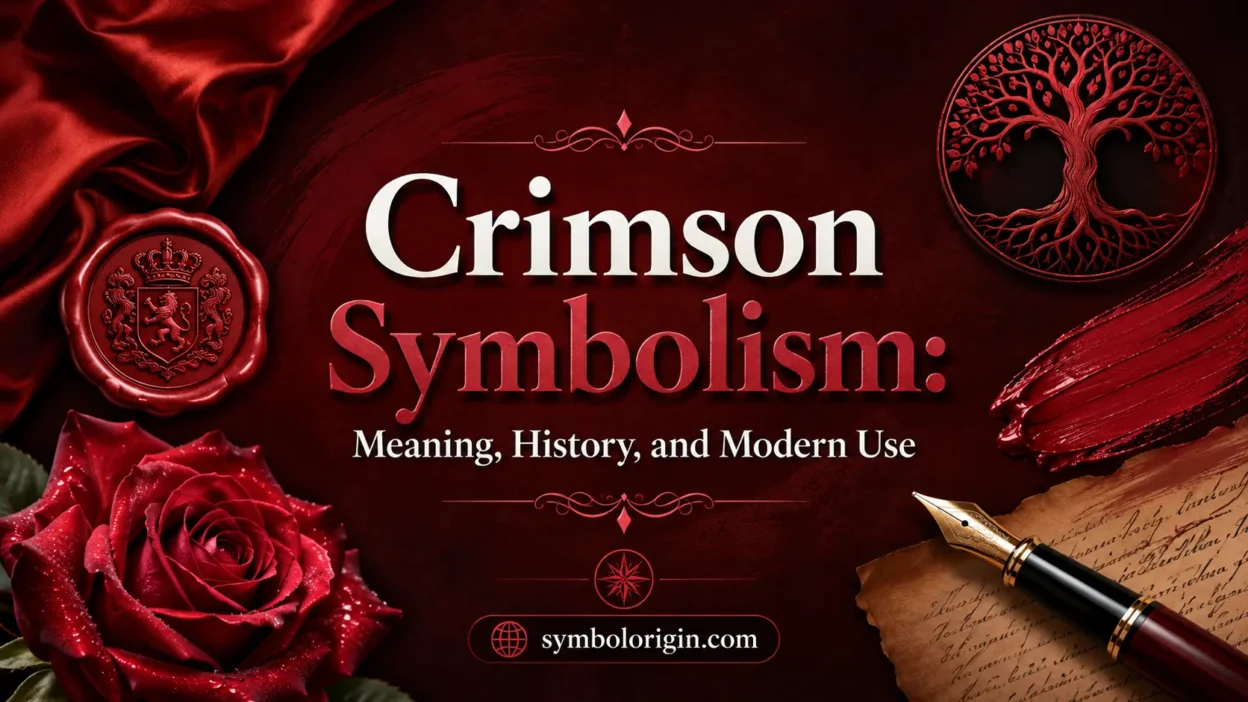
Crimson is a dark, saturated red that sits between bright scarlet and deeper wine-colored shades. Crimson symbolism commonly centers on passion, courage, blood, sacrifice, authority, and emotional intensity, but the color can shift from romantic to threatening depending on where it appears.
That flexibility comes partly from crimson’s long history. Before synthetic dyes made strong reds easy to produce, rich crimson textiles could require valuable natural dyes and skilled labor. As a result, the color became connected not only with blood and emotion but also with wealth, ceremony, prestige, and public identity.
In the United States today, crimson appears in college traditions, sports branding, formal clothing, interior design, religious imagery, tattoos, and digital graphics. Its meaning usually comes from a combination of its red base, its darker tone, and the cultural setting around it.
Quick Answer
Crimson symbolism most commonly represents passion, courage, strength, sacrifice, and intense emotion in modern American culture. Historically, its connections with costly red dyes, blood, religious imagery, and prestigious clothing also gave crimson associations with status, authority, devotion, and consequence.
TL;DR
- Crimson commonly represents passion, courage, sacrifice, and strong emotion.
- Historic crimson dyes helped connect the color with wealth and status.
- Blood associations can suggest life, bravery, danger, or violence.
- Americans also recognize crimson through universities and sports traditions.
- Darker crimson often feels more formal and serious than bright red.
- Cultural context determines whether crimson feels romantic, sacred, or threatening.
What Does Crimson Look Like?
Crimson is usually understood as a strong, deep red with a slightly cool or bluish cast. It is darker and less orange than scarlet, yet typically brighter and more obviously red than burgundy or maroon.
There is no single historical crimson that perfectly matches every modern digital color value. The word originally referred to red coloring associated with natural dyes rather than a standardized screen code. Modern brands and institutions therefore use their own specific versions of crimson.
This distinction matters symbolically. Bright fire-engine red can feel immediate, loud, and urgent, while crimson usually feels heavier and more controlled. That darker appearance helps explain why crimson often communicates mature passion, formality, determination, or seriousness instead of simple excitement.
What Crimson Commonly Means in the United States
In American culture, crimson tends to inherit many meanings associated with red while adding a sense of depth and gravity.
| Context | Meaning in the USA | Common Associations | Notes |
|---|---|---|---|
| Romance | Passion and desire | Love, attraction, intimacy | More mature than pink |
| Sports | Pride and loyalty | Teams, competition, school spirit | Meaning depends on institution |
| Religion | Sacrifice and devotion | Blood, martyrdom, redemption | Strongest in Christian contexts |
| Fashion | Confidence and drama | Formality, sensuality, luxury | Dark shades appear sophisticated |
| Tattoos | Intensity and commitment | Love, courage, loss, survival | Meaning depends on the image |
| Warning imagery | Danger or severity | Blood, conflict, urgency | Context creates the negative meaning |
Crimson therefore rarely has only one interpretation. A crimson rose may communicate romantic commitment, while a crimson banner at a football game may mean nothing more than school loyalty.
Why Crimson Feels More Intense Than Ordinary Red
Crimson belongs to the red family, so many emotional reactions associated with red influence the way people perceive it. Research on color psychology has linked red with heightened attention and arousal, although scientists emphasize that color responses depend heavily on context, culture, surrounding colors, and personal experience. Research generally studies red as a broader category rather than proving a unique psychological effect for crimson itself.
Visually, crimson also combines saturation with darkness. That difference can make it feel less playful than cherry red and less aggressive than some brighter signal reds.
For that reason, designers may use crimson when they want energy without making a composition look childish or excessively loud. The shade can communicate confidence, seriousness, sensuality, or controlled intensity.
Emotionally, crimson often fits experiences that feel consequential: committed love rather than a casual crush, sacrifice rather than ordinary effort, or determination rather than brief excitement.
Ancient Dye Origins Helped Shape Crimson’s Meaning
The history of the word itself helps explain the symbolism.
“Crimson” entered English through earlier European and Arabic forms connected with kermes, a red dyestuff obtained from scale insects living around parts of the Mediterranean. English use of the word dates to the 15th century.
Producing vivid, durable reds in earlier centuries was not as simple as selecting a factory-made pigment. Natural red dyes could require specialized knowledge, significant labor, trade networks, and expensive materials.
Kermes produced prestigious red textiles long before industrial chemistry transformed the dye industry. After European contact with the Americas, cochineal from Mexico and other parts of the Americas became enormously important because it could produce exceptionally strong reds. Cochineal eventually competed with and displaced older red dye materials in many markets.
These material realities gave saturated reds an economic dimension. A striking crimson garment could advertise access to expensive cloth, skilled dyeing, trade, or institutional wealth.
How Crimson Became Associated With Wealth and Authority
Crimson’s prestige did not develop simply because people decided dark red looked royal. Historically, color could reveal what resources a person or institution could afford.
Strong red textiles appeared in military, courtly, ceremonial, and elite settings across different societies. Cochineal red later became especially valuable in international trade and was associated with power and luxury in early modern Europe.
This history still influences modern visual language.
Crimson velvet, for example, can suggest an old theater, a formal chamber, ceremonial clothing, or a luxury interior. Pairing crimson with gold strengthens that impression because the combination recalls decorated textiles, formal emblems, and expensive furnishings.
Today, someone can buy crimson fabric cheaply, so the original economic barrier has largely disappeared. The cultural memory of grandeur, however, remains.
Crimson in Christian and Biblical Symbolism
Crimson carries especially complex meaning in Christian interpretation because red can represent both wrongdoing and redemption.
A well-known biblical image contrasts sins described as scarlet or red like crimson with becoming white. In that setting, the vivid dyed color functions as an image of a visible, serious stain rather than as a universal statement that crimson itself always symbolizes evil.
Elsewhere in Christian visual tradition, red is associated with blood, sacrifice, martyrdom, and the suffering of Christ. Liturgical uses of red can also relate to Pentecost and the Holy Spirit.
Because of these traditions, crimson religious artwork may communicate sacrifice, human mortality, devotion, suffering, or redemption.
Context is essential. A crimson church textile does not automatically symbolize sin, just as a crimson flower does not automatically symbolize sacrifice. The surrounding story determines which association matters.
Crimson as a Symbol of Blood, Life, and Sacrifice
Few associations shape crimson more strongly than blood.
Because crimson resembles the appearance of deep red blood, artists and writers can use the color as a substitute for showing blood directly. That association creates several meanings at once.
Blood can represent life because it is physically necessary for survival. It can represent kinship through ideas such as bloodlines and family bonds. It can represent sacrifice when someone is injured or dies for another person, community, or cause.
The same connection can turn negative. In violent imagery, crimson may suggest wounds, death, warfare, revenge, or guilt.
This is one reason crimson works well in dramatic storytelling. The viewer can see the same shade as noble sacrifice in one scene and threatening violence in another.
Passion, Romance, and Desire
Red has a long modern association with romantic love, and crimson gives that familiar symbolism a darker, more mature tone.
Bright red often communicates open attraction and excitement. Crimson can suggest desire with greater seriousness. It may imply commitment, longing, sensuality, or love that carries emotional risk.
That makes crimson appropriate for romantic flowers, evening clothing, lipstick, wedding accents, Valentine-themed design, and intimate interiors.
Yet crimson is not automatically romantic. A crimson dress in a love story may emphasize attraction, while the same dress in a thriller could make a character appear dangerous or dominant.
The surrounding imagery tells viewers whether the emotional intensity should be understood as affection, temptation, confidence, jealousy, or threat.
Courage, Strength, and Determination
Crimson can also symbolize courage because of its connections with blood, struggle, and physical risk.
The idea is easy to understand: bravery becomes most meaningful when something important is at stake. Colors that recall blood or conflict can therefore represent a willingness to face danger.
In sports, crimson can communicate competitive determination. In heraldic or military-inspired design, it may feel disciplined and forceful. In personal artwork, it can represent surviving hardship or defending a principle.
Crimson is especially effective for this meaning because its darker tone usually appears steadier than brighter reds. Instead of explosive energy, it can suggest endurance and resolve.
That difference makes crimson suitable for themes of resilience where the message is not simply “fight,” but “keep going despite the cost.”
Danger, Anger, and Violence
Crimson also has an unmistakable darker side.
Red is widely used in American warning systems because it attracts attention and has established associations with danger, prohibition, heat, fire, and emergencies. Crimson itself is less common than brighter red for functional warning signs, but visual storytelling often uses deep red to intensify scenes involving danger.
A crimson sky in a horror poster may suggest catastrophe. Crimson stains can imply blood. Dark red lighting can make a room feel threatening or claustrophobic.
Anger is another familiar connection. Flushed skin, heated emotion, and expressions such as “seeing red” reinforce the broader cultural link between red and aggression.
These meanings are contextual rather than automatic. A crimson couch does not communicate violence simply because of its color. Negative symbolism becomes stronger when crimson appears beside weapons, darkness, flames, distressed textures, or threatening language.
Crimson in American Schools, Sports, and Group Identity
Crimson has an unusually visible place in American institutional identity.
Harvard provides one of the best-known examples. Crimson first became associated with Harvard rowing in 1858, when crew members used crimson silk handkerchiefs so spectators could distinguish them during a regatta. Harvard formally adopted crimson as its official color in 1910.
The University of Alabama provides another major American example. Its brand identity prominently uses a deep crimson shade, reinforcing the color’s connection with collegiate sports and the Alabama Crimson Tide.
In these situations, crimson does not primarily mean romance, blood, or religion. It means belonging.
Fans wearing crimson may communicate loyalty, regional identity, alumni connection, tradition, rivalry, or pride. Repetition over generations can make an institutional color emotionally important even when its older symbolism is irrelevant.
This is a useful reminder that color meaning often develops through shared experience rather than ancient symbolism.
Luxury, Formality, and Status
Crimson remains effective when designers want something richer than standard red.
In fashion, deep crimson can make formal clothing feel confident without reaching the brightness of scarlet. Velvet, satin, silk, leather, and polished surfaces amplify the impression because those materials interact dramatically with a dark saturated color.
Interior designers may use crimson in dining rooms, libraries, theaters, lounges, or accent pieces when they want warmth combined with visual weight.
Gold, brass, black, cream, or dark wood can push crimson toward luxury and tradition. White or pale gray can make it look cleaner and more contemporary.
Because crimson commands attention, large amounts can dominate a room. Small accents often create a more controlled impression.
Symbolically, the result tends to fall somewhere between authority, ceremony, sensuality, and confidence.
Crimson in Fashion and Personal Style
Choosing crimson clothing can send a different message from choosing bright red.
A vivid red outfit may appear energetic and highly attention-seeking. Crimson often feels more deliberate. It can project confidence while remaining suitable for formal or professional styling when used carefully.
Crimson lipstick can signal glamour or classic drama. A crimson evening dress may appear romantic or sophisticated. A tie, scarf, handbag, or shoe can introduce intensity without controlling the entire outfit.
The symbolism also changes according to the wearer.
For one person, crimson may represent boldness. Another may wear it because it belongs to a school, organization, or sports team. Someone else may simply prefer dark red aesthetically.
Personal style creates meaning through intention, not color dictionaries alone.
Crimson Tattoos, Jewelry, and Personal Symbols
Crimson often appears as a supporting color in tattoos rather than as a symbol by itself.
A crimson rose can suggest passionate love, remembrance, grief, or devotion. Crimson flames may represent danger, anger, transformation, or determination. A crimson heart can emphasize romantic attachment, while red drops or wounds may represent sacrifice, trauma, mortality, or survival.
Jewelry uses crimson in a similar way. Deep red stones or enamel can evoke love, confidence, vitality, ceremony, or luxury.
The object matters more than the shade alone.
A crimson bird, flower, sword, heart, moon, or religious image will inherit meaning from both the subject and the color. Interpreting only the crimson portion can therefore produce an incomplete reading.
Crimson Across Cultures
Crimson should not be treated as if it has one universal meaning.
Different languages and traditions divide the red color family differently, so the English distinction between crimson, scarlet, ruby, maroon, and other reds does not always map neatly onto another culture’s categories.
In many Chinese cultural contexts, saturated red is associated with celebration, happiness, good fortune, prosperity, and weddings. Red remains especially visible in traditional celebrations and marriage customs.
Other traditions have used strong reds in religious garments, elite textiles, military clothing, ceremonial objects, and decorative arts.
These similarities do not mean every culture assigns crimson the same symbolism. Often the broader color red carries the cultural meaning, while English speakers later describe a particular object as crimson.
For accurate interpretation, cultural setting should come before a generic color definition.
How Crimson Works in Modern Design and Digital Culture
Modern designers use crimson because it attracts attention while providing more visual weight than many brighter reds.
On websites, packaging, posters, social graphics, and logos, crimson can communicate seriousness, confidence, heritage, luxury, or intensity. It works particularly well when a brand wants the excitement of red without looking overly playful.
Social media has also loosened color symbolism. Crimson backgrounds may appear in gothic aesthetics, romantic edits, sports graphics, fantasy artwork, luxury branding, autumn imagery, or dramatic quote cards.
Dark-mode designs frequently combine crimson with black or charcoal. That pairing tends to feel intense, cinematic, or rebellious.
With cream or beige, crimson can appear historical and refined. With pink, it becomes more romantic. With gold, it tends toward ceremony or luxury. With white, it can feel collegiate or athletic.
The meaning is therefore relational: neighboring colors help determine what crimson communicates.
Common Misunderstandings About Crimson
One common mistake is assuming crimson always has a spiritual meaning.
There is no universal spiritual code in which crimson automatically means courage, transformation, divine protection, or a particular type of energy. Those interpretations may exist within specific belief systems, but they should not be presented as objective facts.
Another mistake is treating crimson and scarlet as interchangeable in every historical source. Both describe strong reds, but historical dye terminology and modern color terminology do not always match perfectly.
Crimson also does not automatically symbolize blood. A university logo, velvet chair, lipstick shade, or floral arrangement may have no violent association whatsoever.
Finally, modern American political symbolism should be handled carefully. Red has strong political associations in contemporary U.S. maps and media, but that does not mean every crimson object is making a partisan statement.
Interpretation works best when the color, object, setting, audience, and cultural tradition are considered together.
How Crimson’s Meaning Changed Over Time
Crimson’s history shows how symbolism evolves when technology and culture change.
At first, the importance of strong red shades was partly material. Producing impressive red textiles could require valuable insect-based dyes, international trade, specialized labor, and considerable expense.
That helped saturated reds signal wealth and authority.
Industrial dyes eventually made crimson shades far easier and cheaper to reproduce. The color no longer needed to indicate economic status.
At the same time, new meanings developed through universities, athletics, advertising, fashion, film, and mass-produced consumer goods. Crimson could now represent a football team as easily as an aristocratic garment.
The older associations never disappeared completely. Instead, new layers accumulated.
That is why crimson can simultaneously feel historic, romantic, luxurious, competitive, sacred, or dangerous without those meanings necessarily contradicting one another.
Frequently Asked Questions
Is crimson a positive or negative symbol?
Crimson can be either. Positive meanings include passion, courage, loyalty, confidence, sacrifice, and prestige, while negative uses may suggest anger, bloodshed, danger, guilt, or violence. Context determines which interpretation fits.
What does crimson symbolize spiritually?
In some religious and spiritual settings, crimson may represent sacrifice, devotion, life, suffering, redemption, or intense commitment. These meanings depend on the tradition and should not be treated as universal spiritual rules.
What does crimson mean in the Bible?
Biblical passages can use crimson or scarlet imagery to represent a vivid stain, including the famous contrast between red-colored sin and cleansing whiteness. Christian traditions also connect red with sacrifice, blood, martyrdom, and redemption.
What does a crimson tattoo symbolize?
A crimson tattoo often emphasizes intensity within the larger design. Depending on the image, the color may strengthen meanings involving love, bravery, grief, sacrifice, survival, danger, or personal commitment.
Is crimson the same as red?
Crimson belongs to the red family, but the words are not identical. Crimson normally describes a deeper, slightly cooler red, while “red” covers a much broader range of shades.
Why is crimson associated with royalty and wealth?
Historic rich-red dyes could be expensive and labor-intensive, making vividly colored textiles valuable possessions. Their use in elite and ceremonial settings helped strong reds develop lasting associations with status, authority, and luxury.
What does crimson symbolize in American culture?
Americans often associate crimson with passion, courage, intensity, formal elegance, and sacrifice. It also has strong institutional meanings because universities and sports programs use crimson as a recognizable color of school identity and loyalty.
Conclusion
Crimson symbolism is best understood as a combination of color, history, and context. Its strongest modern meanings include passion, courage, sacrifice, confidence, prestige, and emotional intensity, while blood and warning imagery can also give it associations with danger, violence, or loss.
Its meaning has expanded considerably from the period when valuable natural dyes helped make saturated red textiles marks of status. American schools, sports, fashion, religious traditions, tattoos, entertainment, and digital design have added new associations without completely erasing the old ones.
Crimson ultimately communicates intensity more reliably than any single emotion. What that intensity means—love, loyalty, authority, sacrifice, celebration, or danger—depends on where the color appears and what surrounds it.