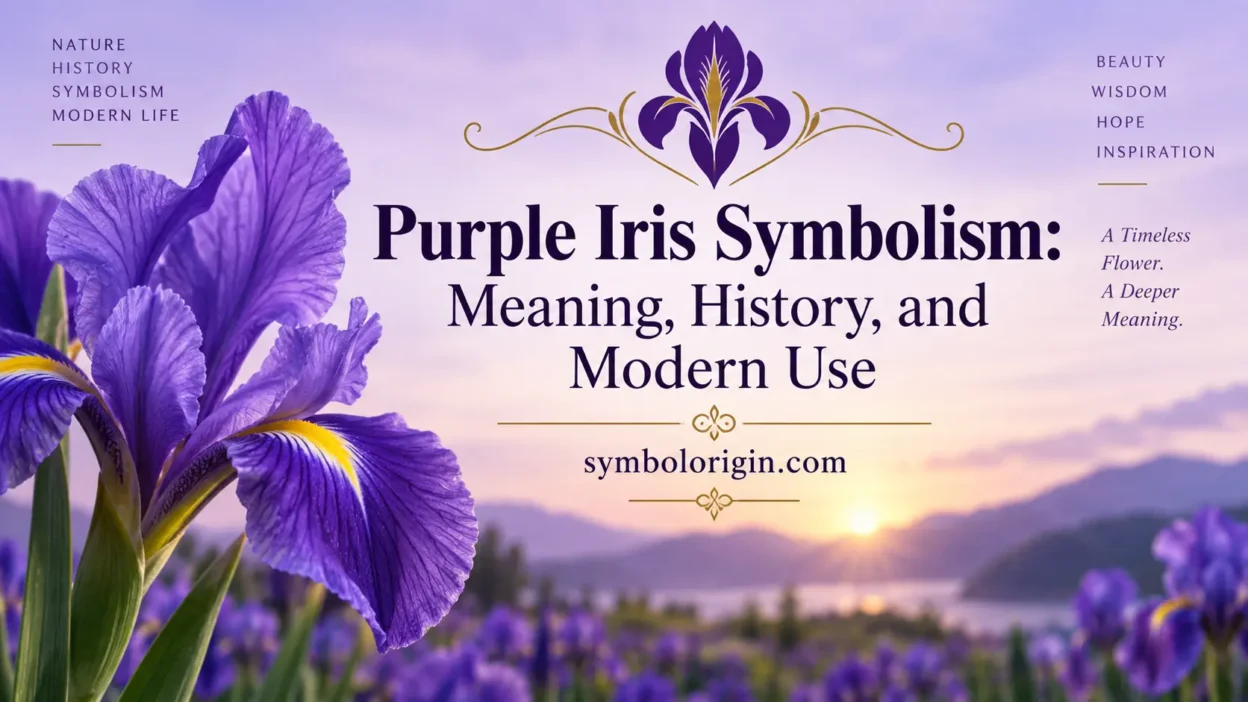
Purple iris symbolism commonly connects this striking flower with wisdom, dignity, hope, and admiration. Its violet petals and distinctive shape make it a popular choice for gardens, bouquets, memorials, and personal designs. In the United States, people often choose purple irises to express respect, celebrate a meaningful relationship, or mark a new chapter in life.
The iris also carries a long cultural history. Its name comes from Greek mythology, while its appearance in European art, religious traditions, and decorative design has added layers of meaning. However, not every interpretation applies to every culture or every flower color.
Understanding the purple iris means looking at both its historical associations and the way people use it today. A flower given to a friend may communicate admiration, while the same bloom in a memorial arrangement may express remembrance and hope.
Quick Answer
Purple iris symbolism commonly represents wisdom, dignity, admiration, and hope in modern American culture, especially in bouquets, gardens, and memorial arrangements. Historically, the iris has also been associated with the Greek messenger goddess Iris, royal imagery, and religious art, although these meanings vary by culture and context.
TL;DR
- Purple irises commonly express wisdom, dignity, admiration, and hope.
- Greek mythology connects the iris with messages and the rainbow.
- Americans use purple irises in gardens, bouquets, and memorials.
- Purple adds associations of refinement, creativity, and respect.
- Tattoos and jewelry often represent personal growth or remembrance.
- Historical meanings should not be treated as universal rules.
What a Purple Iris Looks Like and Where You See It
The iris is a flowering plant known for its upright petals and three lower petals that spread outward. Many varieties have a distinctive shape that makes the flower easy to recognize. Purple irises range from pale lavender to deep violet, and some display contrasting yellow, white, or darker markings.
The name “iris” refers to a large genus of flowering plants rather than one single species. Bearded irises, Siberian irises, and Japanese irises are among the types Americans may encounter in gardens. Their growing needs and flower shapes differ, but many share the recognizable iris form.
In the United States, purple irises appear in home landscapes, botanical gardens, floral arrangements, greeting cards, and decorative artwork. They bloom most often in spring or early summer, depending on the variety and climate. Their seasonal appearance helps explain why people sometimes associate them with renewal and the return of warmer weather.
The flower’s structure also contributes to its appeal. Its tall stems and sculptural petals create an impression of poise, while its color can feel calm or dramatic depending on the shade. These visual qualities influence modern interpretations, even when no historical tradition is involved.
What Purple Irises Commonly Mean in the United States
In contemporary American flower language, purple irises most often communicate admiration, respect, wisdom, and hope. They can also suggest dignity, creativity, and a thoughtful approach to change. These meanings are cultural associations rather than fixed definitions.
A bouquet of purple irises may be appropriate for a mentor, teacher, parent, or friend whose judgment and character someone admires. Unlike a red rose, which often carries a direct romantic message, a purple iris can express appreciation without necessarily suggesting romance.
The flower also works well for occasions that combine celebration with reflection. A graduation arrangement may represent wisdom gained through experience. A retirement bouquet may honor a person’s achievements and the next stage of life. In a sympathy arrangement, the same flower may communicate respect and hope for comfort.
Context matters more than a single flower dictionary definition. The relationship between the giver and recipient, the occasion, and the accompanying message all shape what the flower communicates.
| Context | Meaning in the USA | Common Associations | Notes |
|---|---|---|---|
| Gift bouquet | Admiration and respect | Wisdom, appreciation | Suitable for mentors or loved ones |
| Memorial arrangement | Remembrance and dignity | Hope, comfort | Meaning depends on family preferences |
| Home garden | Renewal and beauty | Spring, resilience | Often chosen for visual appeal |
| Wedding flowers | Elegance and individuality | Commitment, refinement | Not a universal wedding symbol |
| Tattoo or jewelry | Personal growth or identity | Wisdom, remembrance | Meaning is usually personal |
Why the Color Purple Changes the Meaning
Purple has long carried associations with status, refinement, and ceremony in many Western traditions. Historically, certain purple dyes were expensive and difficult to produce, which helped connect the color with wealth and authority. Over time, those associations influenced art, clothing, and decorative symbolism.
When applied to an iris, purple can strengthen ideas of dignity, admiration, and elegance. A deep violet bloom may appear formal and dramatic, while a pale lavender iris may feel softer and more reflective. These impressions come partly from color conventions and partly from individual taste.
Modern color psychology does not establish one universal emotional response to purple. People may associate it with creativity, calm, spirituality, or luxury, but those reactions vary with culture and personal experience. It is more accurate to describe these as common associations than as scientific rules.
The combination of purple and the iris’s upright form creates a flower that many people perceive as graceful without being delicate. This makes it useful in designs intended to communicate confidence, maturity, or quiet strength.
Greek Mythology and the Origin of the Iris Name
The iris takes its name from Iris, the Greek goddess associated with the rainbow and the delivery of messages between gods and humans. In classical mythology, Iris served as a messenger, and the rainbow provided a natural connection to her name.
The Greek word iris means rainbow, a fitting name for a genus that includes flowers in many colors. The mythological association helped establish the iris as a flower connected with communication, transition, and the link between different realms.
Some later interpretations connect irises with guidance for the dead or messages between the living and the departed. These ideas appear in discussions of ancient and later funerary traditions, but they should not be presented as a single, universally practiced Greek custom. Evidence for specific rituals varies, and modern flower meanings often simplify complex historical traditions.
For American readers today, the mythology offers a useful explanation for why the iris can represent hope or a meaningful transition. The flower does not need to carry a literal religious message to evoke the idea of moving from one stage of life to another.
How European Art and Royal Imagery Shaped Its Meaning
Irises appear in European painting, textiles, heraldry, and decorative arts. Their distinctive form made them useful as both natural subjects and stylized motifs. Over time, these appearances helped connect the flower with refinement, beauty, and formal settings.
The fleur-de-lis is especially relevant, although its exact botanical origin remains debated. The stylized emblem is often associated with lilies, but some interpretations connect its shape to the iris. It became a major symbol of French royalty and later appeared in many other heraldic and civic contexts.
It would be inaccurate to claim that every fleur-de-lis represents a purple iris. The emblem has its own history, and its meaning depends on the institution or culture using it. Still, the visual relationship between the flower and the motif helps explain why irises sometimes acquire associations with nobility and dignity.
European artists also used irises for their color, shape, and seasonal beauty. In some works, the flower carries religious or symbolic meaning; in others, it serves primarily as a botanical or decorative subject. The surrounding imagery is essential when interpreting a particular painting.
Purple Iris Symbolism in Christianity and Religious Art
In Christian art, irises sometimes appear in scenes associated with the Virgin Mary, the Annunciation, or the Passion of Christ. Depending on the artwork, they may suggest sorrow, purity, faith, or the suffering associated with Mary’s role in Christian tradition.
The flower’s sword-shaped leaves have contributed to interpretations involving sorrow or piercing grief. However, these meanings belong to particular artistic and devotional contexts. They are not universal Christian teachings about every iris.
Purple itself has religious associations in several Christian traditions, including penitence and preparation during seasons such as Lent and Advent. That does not mean a purple iris automatically represents Lent or has a fixed biblical meaning. The color and flower may carry separate associations that artists or worshippers combine in specific settings.
The Bible does not provide a standard definition of purple iris symbolism. Modern claims that assign the flower a precise biblical message should therefore be treated cautiously unless they refer to a particular artwork, tradition, or historical text.
Cross-Cultural Meanings of the Iris
The iris has different associations across cultures, and these should not be merged into one universal meaning. In Japan, certain irises have historical connections with seasonal celebrations, especially traditions surrounding Children’s Day and the former Boys’ Festival. Their sword-like leaves helped link them with protection, strength, and martial imagery in some contexts.
Japanese iris varieties also hold an important place in garden design and flower appreciation. Their cultural role includes aesthetics, seasonal observation, and horticultural tradition, not only symbolic interpretation.
In China, irises appear in gardening and artistic contexts, and some modern flower-language sources associate them with messages, friendship, or good news. However, meanings differ by species, region, and source. It is best to avoid assigning one fixed Chinese interpretation to all purple irises.
In Western flower language, purple irises are often linked with wisdom and compliments or admiration. These associations developed through changing social customs and popular flower dictionaries rather than one continuous ancient tradition. Today, Americans may draw from several of these traditions while giving the flower a personal meaning.
Hope, Wisdom, and the Emotional Meaning of the Flower
The purple iris can communicate hope because it blooms as the growing season returns and because its mythological name connects it with the rainbow. These associations make it a natural choice for people marking recovery, transition, or a fresh beginning.
Wisdom is another common interpretation. The flower’s formal appearance and long cultural history may contribute to this association, but wisdom is not an inherent property of the plant. People use the iris to represent qualities they admire in themselves or others.
Emotionally, the flower can express respect without excessive sentimentality. It may suit someone who wants to acknowledge grief, gratitude, or achievement in a restrained way. Its upright shape and rich color often make it feel composed rather than playful.
Personal experience can also change the meaning. A purple iris may remind someone of a grandmother’s garden, a childhood home, or a meaningful spring. In those cases, the private association may matter more than any traditional interpretation.
Purple Irises in American Gardens and Seasonal Traditions
Purple irises are familiar plants in American gardens, particularly in regions where their growing conditions are suitable. Gardeners value them for their varied colors, distinctive blooms, and ability to return year after year when properly cared for.
Their spring flowering can make them symbols of renewal, but this meaning is usually informal. Unlike poinsettias at Christmas or red poppies in certain remembrance traditions, purple irises do not have one nationally recognized American holiday meaning.
The iris is also the state flower of Tennessee, where the purple iris is widely associated with the state’s floral identity. This civic connection gives the flower a specific American context beyond general flower language. The state designation does not mean every purple iris represents Tennessee, but it can carry that meaning in local art, gifts, and celebrations.
In home gardens, the flower may represent continuity. A family that divides and replants iris rhizomes can pass the same plants between generations. The resulting symbolism comes from the act of sharing and caring for the plant rather than from a prescribed cultural rule.
What Purple Irises Mean in Bouquets and Special Occasions
Purple irises are versatile flowers because they can communicate admiration without requiring a romantic interpretation. They work well in arrangements for birthdays, graduations, retirements, and expressions of thanks.
For a teacher or mentor, the flower may suggest respect for knowledge and guidance. For a friend, it may communicate appreciation and encouragement. For a partner, it can add elegance and individuality to a bouquet, especially when combined with flowers that carry a more explicitly romantic message.
In weddings, purple irises may represent dignity, commitment, or personal style. Some couples choose them because of their color palette or family associations rather than a traditional meaning. They can appear in bouquets, centerpieces, or garden ceremonies.
Florists also use irises in sympathy arrangements. Their upright stems and distinctive petals can create a formal, respectful appearance. When selecting flowers for a memorial, it is wise to consider the family’s preferences, religious background, and any specific meaning the deceased attached to the flower.
Memorials, Grief, and Remembrance
A purple iris can serve as a symbol of remembrance when it is connected to someone’s life or a shared memory. Its associations with dignity and hope make it suitable for memorial gardens, sympathy cards, and commemorative artwork.
The flower may also represent the continuation of love after loss. A person might plant irises in memory of a relative who enjoyed gardening or choose them for an arrangement because they were the person’s favorite flowers. These personal connections often create a more meaningful tribute than a generic symbolic definition.
Historical associations with Iris as a messenger sometimes inspire modern interpretations of communication between the living and the dead. Such meanings should be understood as poetic or spiritual beliefs, not as established facts about the flower.
For people who prefer a secular interpretation, the iris can simply represent remembrance, gratitude, and the return of life each spring. Its meaning does not require belief in supernatural messages or a particular religious tradition.
Why People Choose Purple Iris Tattoos and Jewelry
Purple iris tattoos often represent wisdom, resilience, personal growth, or remembrance. The flower’s recognizable shape allows artists to create designs ranging from detailed botanical illustrations to simple linework.
A single iris may symbolize an individual journey or a person the wearer wants to honor. A bouquet can represent family members, relationships, or several important life experiences. Adding a date, name, or other element can make the meaning more specific.
The design also affects the impression. A realistic purple iris emphasizes botanical beauty, while a minimalist outline may communicate simplicity and restraint. A flower shown in bloom can suggest renewal, although there is no universal rule that determines its meaning.
Jewelry featuring irises may carry similar associations. Pendants, rings, and brooches can serve as reminders of a loved one, a personal value, or a meaningful place. In both tattoos and jewelry, the wearer’s explanation is more reliable than an outside interpretation.
Purple Irises in Home Decor, Fashion, and Digital Culture
In home decor, purple irises often create an impression of elegance and natural beauty. Their tall form works well in floral prints, wallpaper, ceramics, and framed botanical art. Deep purple can add contrast to a room, while lavender shades may create a softer atmosphere.
Fashion designers may use iris motifs for their sculptural petals and distinctive color. The flower can appear in embroidery, scarves, accessories, and printed fabrics. In these settings, the design may communicate refinement or creativity without carrying a specific historical message.
Digital culture has also made flower imagery easier to personalize. People use purple iris photographs in social media posts, digital illustrations, and memorial graphics to express appreciation, grief, or seasonal change. A caption or surrounding image usually provides the intended meaning.
The flower’s visual appeal remains important. Not every use is symbolic, and a purple iris in a design may simply be chosen because it is beautiful. Recognizing that distinction prevents ordinary decoration from being overinterpreted.
Common Misunderstandings and Distorted Meanings
One common misunderstanding is that every purple iris has the same meaning in every culture. Flower language changes across time and place, and many modern definitions come from popular guides that simplify older traditions.
Another misconception is that the iris and fleur-de-lis are identical symbols. They share visual and historical connections in some interpretations, but the fleur-de-lis has a separate heraldic history. It should not automatically be described as a purple iris.
Some online explanations also assign precise supernatural meanings to the flower, such as guaranteed messages from spirits or predictions about future events. These claims reflect personal beliefs or modern interpretations rather than verifiable properties of the plant.
Cultural context matters when using religious or traditional imagery. A design inspired by Japanese seasonal customs, Christian art, or French heraldry should be described accurately rather than treated as interchangeable decoration. Respectful interpretation begins with understanding the specific tradition involved.
How the Meaning Has Evolved Into 2026
The iris’s meaning has changed as it moved through mythology, art, gardening, and modern flower language. Its Greek name connected it with the rainbow and communication, while European traditions added religious, artistic, and heraldic associations.
During the nineteenth century, popular flower dictionaries helped spread simplified meanings for many flowers. These guides influenced later interpretations, but they did not establish one permanent definition. Modern flower language continues to adapt to personal taste and changing social customs.
In the United States, the purple iris now functions as both a traditional and personal symbol. It can express admiration in a bouquet, remembrance in a garden, or individuality in a tattoo. Its meaning often comes from the occasion and the person using it.
As of 2026, digital imagery and personalized design have made these interpretations more flexible. People may combine historical associations with family memories, favorite colors, or personal milestones. The flower’s cultural history provides context, but it does not limit what an individual may choose to express.
Frequently Asked Questions
What does a purple iris symbolize in a relationship?
A purple iris can represent admiration, respect, and appreciation between partners. It may also express a desire for a thoughtful, lasting connection, although it is not a universally recognized romantic flower.
Is a purple iris a symbol of good luck?
Some people associate irises with hope, positive change, or good news because of their mythological and flower-language connections. However, there is no universal tradition that guarantees good luck from a purple iris.
What does a purple iris tattoo mean for a woman?
A purple iris tattoo may represent wisdom, independence, personal growth, or remembrance, but its meaning is not determined by gender. The wearer’s experiences and design choices provide the most accurate interpretation.
Does the purple iris have a biblical meaning?
The Bible does not assign a specific meaning to the purple iris. In Christian art, irises may appear in religious scenes and can carry associations with sorrow, faith, or purity depending on the artwork.
What is the difference between purple and blue iris symbolism?
Purple irises are commonly associated with dignity, wisdom, and admiration, while blue irises are often linked with hope, faith, or calm. These distinctions come from modern flower language and color associations, so they should not be treated as fixed historical rules.
Are purple irises appropriate for funerals?
Yes, purple irises can be appropriate for funerals and memorial arrangements because they may express respect, remembrance, and hope. The family’s preferences and the deceased person’s connection to the flower should guide the choice.
What does it mean to give someone purple irises?
Giving someone purple irises often communicates admiration, gratitude, or respect. The exact message depends on the occasion, the relationship, and any personal note included with the flowers.
Conclusion
Purple iris symbolism brings together wisdom, dignity, admiration, and hope, while its historical associations add connections to mythology, art, and cultural tradition. In modern American life, the flower is especially meaningful in bouquets, gardens, memorials, and personal designs.
Its interpretation depends on context. A purple iris can honor a mentor, remember a loved one, celebrate a new beginning, or simply bring beauty into a home. The most meaningful use is often the one that connects the flower’s familiar associations with a real person or experience.