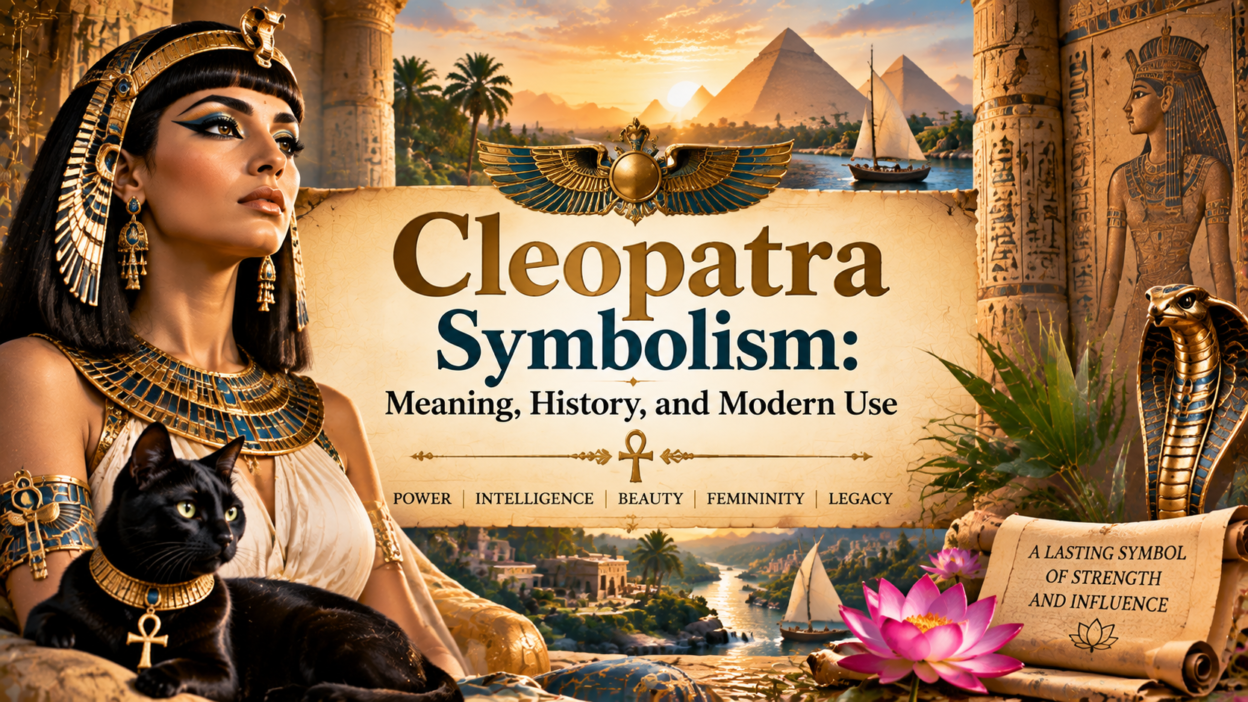
Cleopatra symbolism represents intelligence, leadership, beauty, ambition, and the complex relationship between power and public image. In modern American culture, Cleopatra is often viewed as a symbol of confidence, independence, and personal influence, while her historical story also reflects politics, diplomacy, and the challenges faced by powerful women.
The name Cleopatra brings to mind one of history’s most recognized rulers, Cleopatra VII Philopator, the final active ruler of ancient Egypt’s Ptolemaic dynasty. Her image has traveled far beyond ancient history and appears in movies, fashion, artwork, jewelry, costumes, and popular culture.
Understanding her symbolism requires looking beyond the famous stories about her beauty. Cleopatra’s lasting image comes from her role as a queen, strategist, scholar, diplomat, and cultural figure whose life became a mixture of historical fact and later storytelling.
Quick Answer
Cleopatra symbolism commonly represents confidence, intelligence, leadership, and feminine independence in modern American culture, especially in fashion, identity, and personal expression. Historically, Cleopatra’s image was connected with royal authority, political strategy, Egyptian heritage, and the complicated relationship between power and reputation.
TL;DR
- Cleopatra symbolizes leadership, intelligence, and confidence.
- Her historical image developed through Egyptian and Roman politics.
- Americans often associate her with beauty and independence.
- Her image appears in fashion, art, and entertainment.
- Modern interpretations separate facts from myths.
What Cleopatra Symbolizes in Modern American Culture
In the United States, Cleopatra is often seen as a symbol of a woman who controls her own image and destiny. Many people connect her with confidence, ambition, and the ability to influence others through intelligence rather than physical strength alone.
Her symbolism is especially common in discussions about powerful women. Cleopatra represents the idea that knowledge, communication skills, and leadership can shape history.
At the same time, American culture has often focused heavily on her beauty and romantic relationships. Movies and popular media sometimes present Cleopatra mainly as a glamorous figure, even though historical records show that her political skills played a major role in her reign.
Today, people may use Cleopatra imagery to express:
- confidence and self-belief
- feminine strength
- elegance and luxury
- leadership and independence
- connection with ancient history
Ancient Roots and Cleopatra’s Historical Symbolism
Cleopatra lived from 69 BCE to 30 BCE and ruled Egypt during a period of political uncertainty. She belonged to the Ptolemaic dynasty, a Greek-speaking royal family that controlled Egypt after the death of Alexander the Great.
Her symbolism began with her position as a pharaoh and political leader. Ancient Egyptian rulers were often connected with divine authority, national protection, and maintaining balance in society.
Cleopatra used traditional Egyptian royal imagery while also presenting herself as a capable ruler in the wider Mediterranean world. She understood the importance of symbols, language, and public appearances.
Unlike many rulers of her era, Cleopatra reportedly learned Egyptian and presented herself as connected with Egyptian traditions. This helped strengthen her image as a legitimate Egyptian queen.
Cleopatra as a Symbol of Intelligence and Knowledge
One of the strongest modern interpretations of Cleopatra is her association with intelligence.
Historical accounts describe her as educated, politically skilled, and able to communicate with different cultures. She reportedly spoke several languages and used diplomacy to protect Egypt’s interests during a difficult period.
Her intelligence symbolism comes from her ability to negotiate with powerful Roman leaders, including Julius Caesar and Mark Antony.
For many modern audiences, Cleopatra represents the idea that knowledge can be a form of power. Her story challenges the stereotype that influence comes only from wealth or military strength.
Cleopatra Symbolism and Feminine Power
Cleopatra is frequently used as a symbol of feminine power because she ruled a major kingdom in a male-dominated world.
Her image appears in conversations about women who challenge expectations and create their own paths. She is often portrayed as someone who used intelligence, confidence, and leadership to protect her country.
However, interpretations of her feminine power have changed over time. Some historical writings emphasized her relationships with powerful Roman men rather than her political achievements. Modern discussions often examine this imbalance and give more attention to her role as a ruler.
| Context | Meaning in the USA | Common Associations | Notes |
|---|---|---|---|
| Fashion and Beauty | Confidence and elegance | Luxury, style, glamour | Often inspired by her royal image |
| Leadership | Intelligence and influence | Strategy, ambition, independence | Connected with her role as queen |
| Art and Media | Historical fascination | Drama, romance, mystery | Often mixes facts with fiction |
| Tattoos | Personal strength | Confidence, identity, empowerment | Usually represents individuality |
Cleopatra’s Connection With Beauty and Appearance
Beauty is one of the most common associations with Cleopatra, especially in Western popular culture. Her name is often linked with dramatic makeup, gold jewelry, elaborate hairstyles, and royal fashion.
However, historians generally separate Cleopatra’s symbolic beauty from historical reality. Ancient sources do not provide a simple picture of her appearance, and some accounts suggest her influence came more from personality, intelligence, and presence than physical beauty.
Modern beauty culture uses Cleopatra as an image of:
- bold personal style
- confidence
- elegance
- self-expression
- dramatic fashion choices
The famous “Cleopatra look” often includes dark eyeliner, gold accessories, and Egyptian-inspired designs.
Cleopatra Symbolism in Art and Entertainment
Cleopatra has remained a popular figure in paintings, theater, films, and television because her life combines politics, romance, conflict, and tragedy.
Artists often use her image to explore themes such as:
- ambition
- love and sacrifice
- cultural identity
- power struggles
- leadership
In American entertainment, Cleopatra is frequently shown as a glamorous queen surrounded by luxury. While these portrayals attract audiences, they sometimes simplify the complexity of her historical role.
Her image continues to evolve because each generation interprets her story through its own cultural values.
Cross-Cultural Meanings of Cleopatra
Cleopatra’s symbolism changes depending on cultural perspective.
In Egyptian contexts, she can represent the final chapter of ancient Egyptian royal history and the blending of Egyptian and Greek traditions.
In European traditions, especially after Roman writers and Renaissance artists revisited her story, she became associated with romance, temptation, and political drama.
In modern global culture, Cleopatra often represents a combination of:
- royalty
- intelligence
- beauty
- independence
- historical mystery
Different cultures have emphasized different parts of her story, creating a wide range of interpretations.
Cleopatra Symbolism in Tattoos and Personal Expression
Cleopatra tattoos are often chosen by people who want to represent confidence, independence, intelligence, or connection with ancient history. The meaning depends on the design, but many people use her image as a personal statement about strength and self-expression.
Common Cleopatra tattoo elements include:
- Cleopatra’s face or portrait: Often represents confidence, leadership, and individuality.
- Egyptian symbols with Cleopatra: May represent cultural interest, history, or connection with ancient civilizations.
- Gold jewelry and crowns: Usually symbolize royalty, achievement, and ambition.
- Eye makeup or the Egyptian eye style: Often connects with beauty, protection, and traditional Egyptian art.
In the United States, tattoo culture frequently uses historical figures as symbols of identity. A Cleopatra tattoo may not represent the actual queen’s entire life story but rather the qualities a person connects with, such as courage, intelligence, or personal power.
Cleopatra and Egyptian Religious Symbolism
Cleopatra ruled Egypt during a period when religion and political authority were closely connected. Egyptian rulers were often viewed as having a special relationship with the gods and the responsibility of maintaining harmony in the kingdom.
Cleopatra associated herself with Egyptian religious traditions, including imagery connected with the goddess Isis. Isis was linked with motherhood, protection, healing, and royal legitimacy.
By connecting herself with Isis, Cleopatra strengthened her image as a rightful Egyptian ruler. This symbolism showed her people that she represented stability and continuity during a period of political pressure.
Today, references to Cleopatra and Egyptian spirituality often appear in:
- historical artwork
- museum displays
- jewelry designs
- fantasy themes
- spiritual-inspired decoration
However, modern uses sometimes combine different Egyptian symbols without following their original religious meanings.
Cleopatra’s Relationship With Myth and Legend
Over time, Cleopatra became surrounded by myths that expanded beyond historical evidence. Stories about her beauty, romance, and dramatic lifestyle became popular through literature and entertainment.
One reason these myths grew is that Roman writers often described Cleopatra through a political lens. Some accounts focused on her relationships with Roman leaders and portrayed her as a dangerous or seductive figure.
Modern historians often examine these stories carefully because ancient political conflicts influenced how people described her.
The mythological image of Cleopatra usually emphasizes:
- mystery
- romance
- temptation
- luxury
- dramatic fate
The historical image focuses more on:
- diplomacy
- leadership
- education
- political survival
Both versions continue to influence how people understand her today.
Common Misunderstandings About Cleopatra Symbolism
Cleopatra’s image has collected many assumptions that do not always match historical evidence.
Cleopatra Was Only Known for Her Beauty
One of the most common misunderstandings is that Cleopatra became famous only because of her appearance. Historical accounts suggest her influence came from her political abilities, education, and communication skills as much as her appearance.
Cleopatra Represented Only Egyptian Culture
Cleopatra ruled Egypt, but her family came from the Greek Ptolemaic dynasty. Her identity reflected a mixture of Greek and Egyptian traditions.
Cleopatra Was a Typical Egyptian Pharaoh
Cleopatra adopted Egyptian royal traditions, but she ruled during a unique period when Greek, Egyptian, and Roman influences interacted.
Her Story Is Completely Historical
Many popular stories about Cleopatra come from later writings, plays, films, and artistic interpretations. Some details remain debated among historians.
Understanding these differences helps separate Cleopatra’s real historical role from fictional versions.
The Evolution of Cleopatra’s Symbolic Meaning
Cleopatra’s symbolism has changed significantly over more than two thousand years.
During her lifetime, she represented Egyptian sovereignty and political resistance against growing Roman control. After her death, Roman writers often presented her as a symbol connected with danger, luxury, and foreign influence.
During the Renaissance, artists and writers became fascinated with her story. She was often portrayed as a tragic queen caught between love and power.
In modern times, Cleopatra’s image has shifted again. Many people now focus on her intelligence, leadership, and ability to navigate difficult political situations.
The evolution of her symbolism shows how historical figures can gain new meanings as societies change.
Cleopatra Symbolism in Fashion, Design, and Pop Culture
Cleopatra’s visual style continues to influence American fashion and entertainment. Her image is often connected with dramatic elegance and ancient-inspired designs.
Modern examples include:
- Halloween costumes featuring Egyptian queens
- gold jewelry inspired by ancient styles
- makeup looks using bold eyeliner
- luxury fashion themes
- movie and television characters
Designers often use Cleopatra-inspired imagery because it combines history with visual drama.
In popular culture, she is frequently presented as a symbol of confidence and sophistication. However, these creative interpretations may focus more on appearance than historical accuracy.
Cleopatra and Identity Symbolism Today
For many people, Cleopatra represents the ability to define oneself despite outside expectations.
Her story is often interpreted as an example of someone who used education, communication, and strategy to maintain influence during a challenging period.
In modern American conversations about identity, Cleopatra may symbolize:
- personal confidence
- ambition
- overcoming limitations
- leadership
- intellectual strength
People may connect with Cleopatra not because they share her exact historical circumstances, but because they relate to the broader themes of resilience and self-determination.
Cleopatra Symbolism in Modern Media and Digital Culture
Digital culture has introduced new ways of interpreting Cleopatra. Social media, online artwork, and entertainment platforms frequently recreate her image for modern audiences.
She appears in:
- digital illustrations
- historical education content
- fashion inspiration posts
- themed photography
- online discussions about powerful women
Online interpretations often highlight confidence and independence. At the same time, digital platforms can spread simplified versions of historical figures.
The challenge is balancing creative expression with respect for historical context.
Positive and Negative Interpretations of Cleopatra
Cleopatra’s symbolism contains both admired and criticized aspects.
| Interpretation | Positive Meaning | Possible Criticism |
|---|---|---|
| Queen imagery | Leadership and authority | Can ignore political complexity |
| Beauty symbolism | Confidence and self-expression | May reduce her to appearance |
| Romance stories | Passion and emotional connection | Can overshadow her achievements |
| Egyptian imagery | Interest in ancient history | May create inaccurate cultural mixes |
These different views show why Cleopatra remains a debated and interesting symbol.
Why Cleopatra Remains Relevant in 2026
Cleopatra remains relevant because modern audiences continue to explore themes connected with power, identity, leadership, and representation.
Her story raises questions that still matter today:
- How do powerful women get remembered?
- How does public image affect reputation?
- How do cultures preserve and reinterpret history?
- How do myths shape our understanding of real people?
Her symbolism survives because it connects ancient history with modern conversations about influence and identity.
Frequently Asked Questions About Cleopatra Symbolism
What does Cleopatra symbolize today?
Cleopatra commonly symbolizes intelligence, confidence, leadership, and independence. In modern American culture, many people view her as an example of a woman who used knowledge and strategy to create influence.
What does a Cleopatra tattoo symbolize?
A Cleopatra tattoo often represents confidence, personal power, elegance, and interest in ancient history. The meaning can change depending on whether the design focuses on her as a queen, beauty icon, or historical figure.
Is Cleopatra a symbol of beauty or intelligence?
Cleopatra is associated with both, but historical discussions often emphasize her intelligence, political skills, and education. Her beauty became a stronger focus through later art and entertainment.
What does Cleopatra symbolize in Egyptian culture?
Cleopatra can symbolize the final period of ancient Egyptian royal history and the connection between Egyptian traditions and the Ptolemaic dynasty. Her image is also connected with ideas of queenship and cultural identity.
Was Cleopatra considered a goddess?
Cleopatra was not a goddess, but she connected herself with Egyptian religious traditions and imagery associated with divine authority. Ancient rulers often used religious symbolism to strengthen their position.
Why is Cleopatra still popular in American culture?
Cleopatra remains popular because her story combines leadership, politics, beauty, romance, and historical drama. Modern audiences continue to reinterpret her image in fashion, entertainment, and personal expression.
Conclusion
Cleopatra symbolism represents a complex combination of leadership, intelligence, beauty, identity, and historical influence. While popular culture often highlights her glamorous image, her lasting importance comes from her role as a skilled ruler who managed political challenges during a difficult era.
In modern America, Cleopatra is often used as a symbol of confidence and self-expression, appearing in art, fashion, tattoos, and entertainment. Understanding Cleopatra symbolism means looking beyond legends and recognizing the many ways her story has been interpreted across time.
Her image continues to change because each generation finds new lessons in the life of one of history’s most recognized queens.