
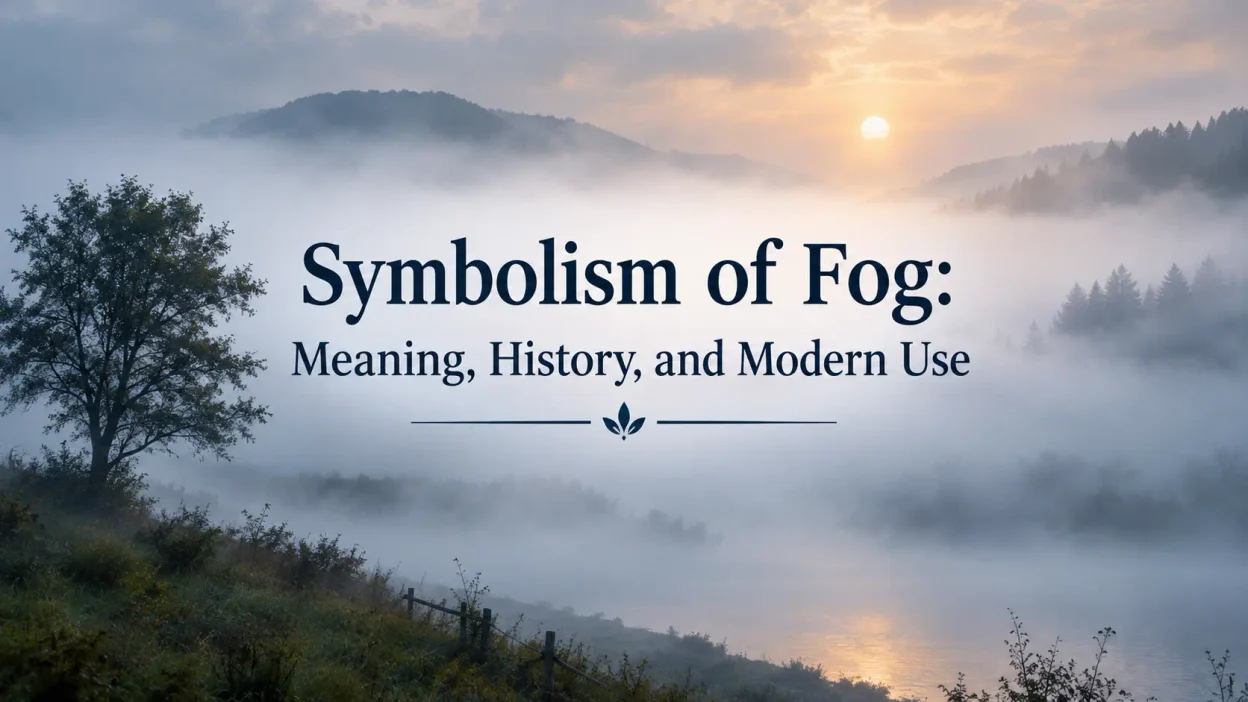
The symbolism of fog often centers on uncertainty, mystery, confusion, and the difficulty of seeing what lies ahead. When fog covers a familiar road, hides a landscape, or softens the outline of a city, it changes how people experience an ordinary place. The world remains there, but its details become harder to recognize.
In the United States, fog appears in literature, horror films, landscape photography, coastal imagery, and everyday descriptions of uncertain situations. People may say they are “in a fog” when they feel mentally overwhelmed, or describe a decision as unclear because they cannot see the full picture. These expressions connect a physical weather condition with an emotional experience.
Fog does not always suggest danger or confusion. It can also represent privacy, calm, transition, imagination, and the quiet beauty of a landscape. Its meaning depends on the setting, the story being told, and whether the fog conceals something threatening or simply invites people to slow down.
Quick Answer
The symbolism of fog most commonly represents uncertainty, confusion, mystery, and limited understanding in modern American culture. Historically, fog has also helped writers and artists suggest supernatural encounters, hidden truths, isolation, and transitions between the familiar and the unknown.
TL;DR
- Fog commonly symbolizes uncertainty, confusion, and incomplete knowledge.
- Folklore and literature use fog to blur boundaries between known and unknown worlds.
- American films often use fog to create suspense, isolation, or supernatural tension.
- Soft morning fog can suggest peace, privacy, and reflection.
- Fog tattoos and artwork may represent mystery, change, or an unclear future.
- The setting determines whether fog feels threatening, comforting, or simply beautiful.
What Fog Represents as a Symbol
Fog forms when tiny water droplets or ice crystals remain suspended near the ground, reducing visibility. It can settle over a highway, drift between trees, cover a shoreline, or gather around buildings. These physical qualities make fog a natural symbol of limited perception: something exists nearby, but the observer cannot see it clearly.
The most familiar symbolic meaning is uncertainty. A person walking through thick fog cannot easily judge distance, identify landmarks, or anticipate what comes next. That experience resembles periods when people face incomplete information, difficult choices, or changes they do not yet understand.
Fog can also represent concealment. A shape hidden in mist may be harmless, but the lack of detail encourages the imagination to fill in the gaps. In stories, this makes fog useful for suggesting secrets, danger, or something waiting just beyond view.
Yet concealment is not always negative. Fog can soften harsh outlines and make a familiar environment feel private or peaceful. In a quiet landscape, it may symbolize rest, contemplation, or the temporary release of everyday distractions.
Uncertainty and the Fear of the Unknown
Fog’s strongest symbolic association comes from its effect on visibility. When people cannot see far ahead, they lose some confidence in their surroundings. A path that seems straightforward in clear weather can become difficult to navigate once fog covers it.
This makes fog an effective metaphor for uncertain periods in life. Someone considering a career change, waiting for important news, or adjusting to a new relationship may describe the future as foggy. The expression does not necessarily mean that the situation is hopeless. It means that the next steps are not yet clear.
In fiction, a fog-covered road may suggest that a character is entering unfamiliar territory. The character might face a moral dilemma, an unexpected discovery, or a situation in which appearances cannot be trusted.
Fog can also express a more ordinary truth: people rarely understand every part of a decision before making it. As a symbol, it captures the discomfort of moving forward without complete certainty.
Mystery, Secrets, and Hidden Truths
Fog conceals details without completely removing them. A building may appear as a shadow, a person as a vague outline, or a distant light as a blurred glow. This half-visibility gives fog a close relationship with mystery.
In a story, a fully hidden object may be absent from the scene, but an object partly visible through fog remains present and intriguing. The audience knows there is something to discover, even if its identity or significance remains unclear.
Writers and visual artists use this effect to suggest secrets, unanswered questions, and unreliable appearances. A foggy setting can make a familiar place seem unfamiliar, encouraging readers or viewers to reconsider what they believe they know.
Fog may also symbolize truths that a person is not ready to confront. A character who avoids an uncomfortable memory might experience a foggy landscape during a moment of hesitation. This interpretation works best when the story connects the weather to the character’s choices rather than treating fog as an automatic sign of hidden wrongdoing.
Confusion, Mental Fog, and Emotional Overload
In everyday American English, “mental fog” describes a feeling of unclear thinking. People use the expression when they struggle to concentrate, organize their thoughts, remember details, or make decisions.
The metaphor works because physical fog interferes with sight while mental fog interferes with clarity. In both cases, information may be present, but it is harder to process or interpret.
In literature, fog may represent a character who cannot understand their own motives or recognize the consequences of a choice. A foggy room or landscape can mirror indecision, grief, shock, or emotional exhaustion without explaining those feelings directly.
The image can also communicate temporary disorientation rather than a permanent condition. Fog eventually lifts in many weather situations, so it may suggest that confusion can ease as time passes or new information becomes available.
This is a figurative meaning, not a diagnosis. When people use “brain fog” to describe real cognitive symptoms, the phrase refers to their experience rather than a specific medical condition by itself.
Fog as a Boundary Between Worlds
Fog can make boundaries difficult to recognize. A shoreline may disappear into mist, the edge of a forest may become indistinct, and the distance between two places may seem uncertain. Because it changes how people perceive space, fog often serves as a symbolic threshold.
In folklore and supernatural fiction, this quality makes fog a natural setting for encounters with the unfamiliar. A character may enter a mist-covered field and emerge in a strange place, meet an unexplained figure, or discover that ordinary rules no longer seem to apply.
Such scenes do not establish a universal belief that fog connects the living world with a spiritual realm. Rather, they use fog’s visual ambiguity to represent a crossing from one state of experience into another.
Fog can also mark a personal transition. A person leaving home, beginning a new stage of life, or abandoning an old identity may be depicted moving through mist. The destination remains uncertain, but the movement itself suggests change.
Historical Roots in Folklore and Literature
Fog has long offered storytellers a practical way to create suspense and uncertainty. Before modern lighting, radar, and reliable weather forecasting, dense fog could make travel and navigation more difficult. Its physical risks helped establish its association with disorientation and vulnerability.
In European folklore, mist and fog sometimes appear in stories involving enchanted landscapes, supernatural beings, or places where ordinary experience gives way to the uncanny. These traditions vary by region and story; they should not be treated as one universal system of belief.
Literature later used fog to build atmosphere and express states of mind. Gothic writing often places characters in shadowy, difficult-to-read environments, where the setting supports feelings of dread, secrecy, or confinement. Fog fits this approach because it hides details while allowing the reader to imagine what might be present.
In nineteenth-century and early twentieth-century writing, urban fog could also reflect the confusion of crowded, rapidly changing cities. In such settings, the weather might create a sense of anonymity or make familiar streets feel unfamiliar. Its meaning depended on the author’s purpose, not simply on the presence of mist.
Fog Symbolism in American Film and Popular Culture
American movies and television have made fog a familiar visual shorthand for suspense. Horror films may place fog around an isolated house, a deserted road, or a small town to suggest that danger is near. The limited visibility delays what viewers can see and creates tension before anything happens.
Crime dramas and thrillers may use fog to make a location feel uncertain or to conceal a character’s movements. Science-fiction stories sometimes use it to suggest an unfamiliar environment, an unexplained event, or a world whose rules remain unclear.
Not every American screen image uses fog negatively. In romantic scenes, mist can soften a landscape and create intimacy. In fantasy films, it may suggest an enchanted forest or a place outside ordinary time. In quiet dramas, it can give a scene a reflective, subdued mood.
These conventions are learned through repeated storytelling. Fog does not naturally mean a monster is nearby; filmmakers use it because viewers have become accustomed to associating reduced visibility with suspense and anticipation.
What Fog Means in the United States Today
In contemporary American culture, fog has both literal and figurative meanings. Weather reports treat it as a visibility and travel concern, while everyday speech uses it to describe uncertainty or unclear thinking. These meanings overlap because both involve difficulty seeing or understanding what is ahead.
The phrase “lost in a fog” may describe someone overwhelmed by competing demands. Calling a plan “foggy” suggests that important details remain unresolved. In a workplace, a team might use the metaphor when goals or responsibilities are not clearly defined.
Fog also appears in American coastal identity and landscape imagery. Communities along the Pacific and Atlantic coasts may experience fog as a familiar feature of local weather rather than an ominous event. In photography and travel imagery, it can create a sense of place, especially around beaches, bridges, mountains, and forests.
Its interpretation therefore depends on context. A fog bank on a dangerous road may signal a practical hazard, while fog drifting over a quiet lake may suggest serenity. The same physical condition can carry different meanings for people who encounter it in different settings.
Positive Meanings: Peace, Privacy, and Imagination
Although fog often suggests uncertainty, its softer qualities can support positive interpretations. Mist reduces visual clutter, muffles the apparent scale of a landscape, and makes familiar surroundings feel temporarily separate from ordinary routines.
For some people, this atmosphere suggests peace. A foggy morning walk may feel quiet because fewer distant details compete for attention. In photography, fog can create gentle layers, muted contrast, and a sense of stillness.
Fog may also represent privacy. When a landscape is partly hidden, it can feel sheltered from public view. In a poem or painting, this effect may communicate solitude that a character chooses rather than loneliness forced upon them.
Imagination is another possible association. Fog leaves gaps in what the observer can see, allowing the mind to picture what might lie beyond the visible scene. This can be comforting or unsettling, depending on the person’s mood and the surrounding details.
A positive interpretation does not require claiming that fog has a fixed spiritual message. It is enough to recognize how its appearance can shape a person’s experience of a place.
Spiritual and Religious Interpretations of Fog
Fog does not have one universal religious meaning. Interpretations vary among traditions, texts, communities, and individual believers, so it is important not to assign a single spiritual message to every appearance of mist.
In some religious or mythic narratives, clouds and mist accompany divine presence, concealment, or encounters with what humans cannot fully understand. In other contexts, obscured vision may serve as an image for limited human knowledge or the need for humility.
Modern spiritual interpretations sometimes treat fog as a metaphor for being between life stages or learning to accept uncertainty. Someone may find personal meaning in walking through mist during a period of reflection, but that experience does not establish a belief shared by all cultures.
A respectful reading begins with the specific tradition or text involved. If a religious artwork depicts fog, its meaning should be considered alongside its other imagery, historical setting, and the beliefs of the people who created or used it.
Psychological Meaning: Vulnerability, Reflection, and Change
Psychologically, fog can represent the tension between wanting certainty and having to live with incomplete information. Its obscuring effect reflects a familiar human experience: people often need to act before they understand every detail.
In a frightening scene, fog may heighten vulnerability because characters cannot easily assess risks. In a quiet scene, the same setting may create room for reflection by reducing distractions and slowing the pace of the story.
Fog can also symbolize a period of transition in which an old identity no longer fits but a new one has not fully taken shape. A person may know that change is necessary without knowing exactly what the outcome will be. The fog represents the unsettled interval rather than the final result.
These readings are possibilities, not psychological rules. A foggy setting may reflect a character’s state of mind, but it may also be included for weather, atmosphere, or visual composition. The surrounding story determines which interpretation makes sense.
Fog in Tattoos, Art, and Home Decor
Fog appears in tattoos and visual design because it can suggest atmosphere without relying on a single literal object. Its meaning usually comes from the other elements in the design and the reason the person chose it.
A fog-covered forest tattoo may represent solitude, a love of nature, uncertainty, or a memorable place. Fog around a mountain range may emphasize a journey whose destination is not fully visible. When paired with a moon, abandoned building, or silhouette, it can create a darker, more suspenseful mood.
In paintings and photography, fog often helps organize the image. Objects in the foreground appear clearer, while distant shapes fade into lighter tones. This creates depth and can draw attention to the relationship between what is visible and what remains hidden.
In home decor, foggy landscape prints may communicate calm, minimalism, or a preference for subdued natural scenes. Their appeal does not depend on a fixed symbolic code. For many people, the effect is primarily visual: the image makes a room feel quiet and uncluttered.
| Context | Common symbolic meaning | Typical emotional effect |
|---|---|---|
| Horror films | Hidden danger or the unknown | Suspense and unease |
| Foggy landscape photography | Stillness and distance | Calm or reflection |
| Tattoos | Uncertainty, solitude, or transition | Personal and context-dependent |
| Everyday expressions | Confusion or incomplete understanding | Frustration or hesitation |
| Spiritual or literary scenes | Mystery or a threshold between states | Wonder, humility, or uncertainty |
Common Misunderstandings About Fog Symbolism
One common mistake is assuming that fog always symbolizes danger. Fog is often used in horror and mystery stories, but it also appears in peaceful landscapes, romantic scenes, and images of solitude. Its meaning depends on the setting and the way it is presented.
Another mistake is treating fog as a universal omen. Some people may personally interpret a foggy morning as a sign of change or reflection, but there is no single interpretation that applies across all cultures and circumstances.
Fog should also not be confused with darkness. Darkness removes or reduces light, while fog scatters light and obscures detail. In visual storytelling, darkness may suggest secrecy or fear, whereas fog can communicate uncertainty, distance, softness, or a mixture of these effects.
Finally, symbolic interpretation should not replace practical understanding. Real fog can make roads, airports, waterways, and outdoor activities hazardous by reducing visibility. Its metaphorical meaning does not change the need to respond carefully to actual weather conditions.
How to Interpret Fog in a Dream, Story, or Image
When fog appears in a dream, painting, film, or personal reflection, begin by considering what it does in the scene. Does it block a path, conceal a person, soften a landscape, or slowly disappear? The action provides more useful clues than the fog alone.
Next, consider the emotional tone. Fear may support an interpretation involving uncertainty or vulnerability. Relief and quiet may suggest privacy or rest. Curiosity may point toward discovery, imagination, or the possibility of change.
The surrounding details also matter. Fog over a familiar home may suggest that something once understood now feels uncertain. Fog along a road may emphasize a difficult decision. Fog lifting over a landscape can suggest new information or a clearer outlook, although it does not guarantee a happy ending.
For personal symbolism, ask what fog means to you based on your experiences. Someone who lives near a foggy coastline may associate it with home and routine, while someone else may connect it with a frightening journey. Personal associations can be meaningful without being universal.
How Fog’s Symbolism Has Evolved
Fog’s symbolic role has changed as people’s environments and media have changed. When visibility was a major obstacle to travel, fog readily suggested physical danger, disorientation, and the limits of human control. Folklore and literature built on these practical experiences to create scenes of uncertainty and supernatural possibility.
Photography, film, and television later made fog an easily recognizable tool for shaping mood. Directors could use artificial fog to obscure a set, reveal a beam of light, or delay the appearance of a character. Repeated use strengthened its association with suspense, even as artists continued to use it for beauty and calm.
Today, fog remains useful because it can describe both a visible condition and an inner state. People use it to talk about unclear plans, uncertain futures, and difficulty thinking, while artists use it to create atmosphere. Its modern meaning is not a complete break from older interpretations; it is an extension of the same basic experience of seeing only part of what is present.
FAQ: Fog Symbolism
What does fog symbolize spiritually?
Fog may symbolize uncertainty, humility, transition, or the limits of human understanding in some spiritual interpretations. Its meaning depends on the specific tradition, text, or personal belief rather than a universal rule.
Is fog a positive or negative symbol?
Fog can be positive or negative. It may suggest confusion, danger, or concealment, but it can also represent calm, privacy, imagination, and a period of transition.
What does fog symbolize in literature?
In literature, fog often creates uncertainty, hides important details, or reflects a character’s confusion. Authors may also use it to create a peaceful atmosphere or mark a transition into unfamiliar territory.
What does fog mean in a tattoo?
A fog tattoo may represent mystery, solitude, an uncertain future, or a personal period of change. Its meaning becomes more specific when combined with elements such as a road, forest, mountain, moon, or figure.
Why is fog common in horror movies?
Fog limits visibility and prevents characters and viewers from seeing what lies ahead. Filmmakers use this effect to build suspense, conceal movement, and make familiar settings feel unfamiliar.
Does fog symbolize a new beginning?
It can, especially when a scene shows fog lifting or a person moving through it toward a new destination. The image suggests that clarity may emerge over time, but this is an artistic interpretation rather than a fixed meaning.
What is the difference between fog and mist in symbolism?
The words often overlap in everyday language, and both can suggest uncertainty, concealment, or calm. In a particular artwork, the visual intensity matters more than a strict symbolic distinction between the two terms.
Conclusion
The symbolism of fog begins with a simple physical fact: fog makes it harder to see what is nearby or ahead. That limitation has made it a useful image for uncertainty, confusion, mystery, and hidden information, while its quiet appearance can also suggest privacy, peace, and reflection.
In American culture, fog moves easily between everyday speech, coastal landscapes, photography, literature, and film. It can represent a frightening unknown or a welcome pause from visual noise. The best interpretation depends on the scene, the emotions it creates, and the associations of the person experiencing it.
Fog does not tell us what lies beyond it. As a symbol, it captures the moment when we must respond to what we can see while accepting that some details remain unclear.


