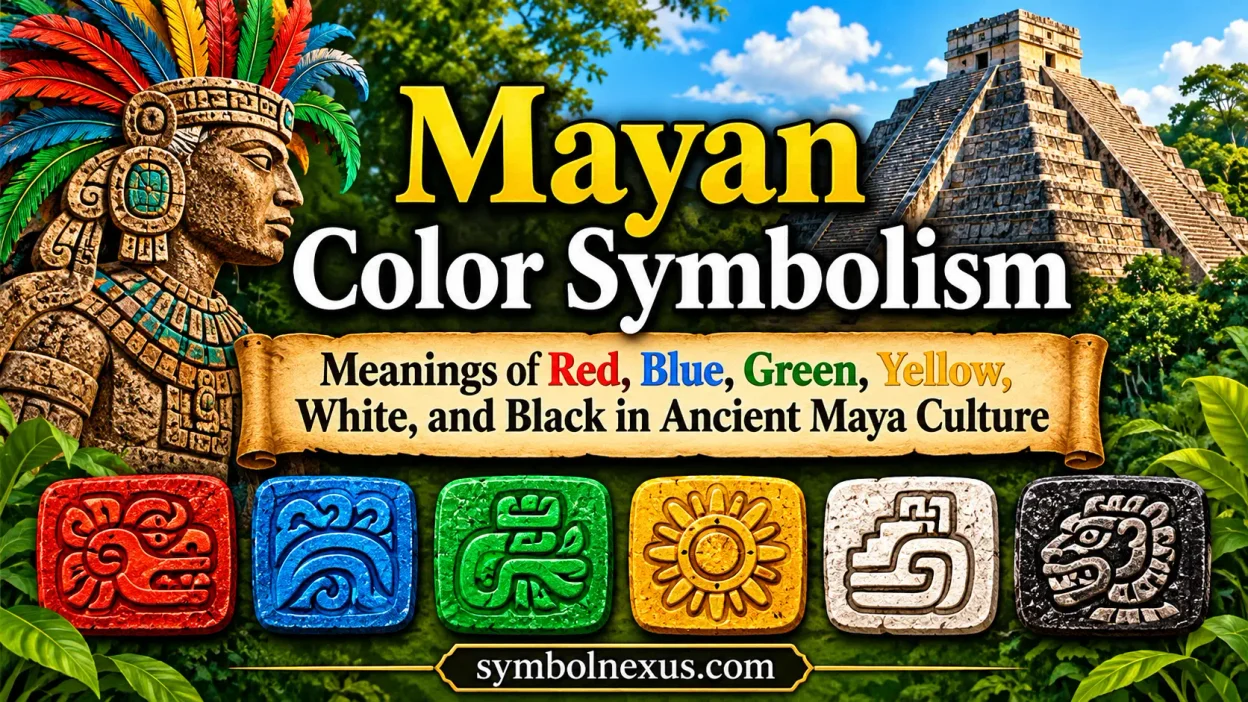
Color played a powerful role in the worldview of the ancient Maya. It was much more than a decorative element in their paintings, temples, pottery, and clothing. Colors helped communicate religious beliefs, represent natural forces, identify sacred directions, and express the relationship between humanity and the universe.
Mayan color symbolism is particularly fascinating because colors were connected with the structure of the cosmos. In several Maya traditions, red, white, black, and yellow represented the four cardinal directions, while green or blue-green was associated with the center of the world. Other colors, including blue and green, carried important associations with water, vegetation, agriculture, sacred offerings, and precious materials.
The Maya also used colors in religious ceremonies, artistic traditions, royal objects, and architectural decorations. Their distinctive Maya Blue pigment, for example, demonstrates their remarkable knowledge of natural materials and artistic techniques.
However, Maya civilization was not culturally uniform. It included many communities across present-day Mexico, Guatemala, Belize, Honduras, and El Salvador, and its traditions developed over thousands of years. Color meanings could differ according to region, historical period, and ceremonial context.
Understanding these differences provides a deeper appreciation of how the ancient Maya connected color with nature, spirituality, agriculture, and the organization of the universe.
What Is Mayan Color Symbolism?
Mayan color symbolism refers to the cultural, religious, artistic, and cosmological meanings associated with colors in ancient Maya civilization.
The Maya used color to communicate ideas about the natural world, sacred geography, agriculture, religious ceremonies, and supernatural beings. Colors could also distinguish important figures, decorate sacred spaces, and express relationships between the human world and the cosmos.
Color appeared in many aspects of Maya life, including:
- Temple murals and architectural decorations
- Painted pottery and ceramic vessels
- Hieroglyphic inscriptions and manuscripts
- Religious ceremonies and ritual offerings
- Traditional clothing and woven textiles
- Sacred objects and ceremonial decorations
- Representations of gods, rulers, and supernatural beings
One of the most important features of Maya color symbolism was its relationship with the cardinal directions.
In several traditions, each direction had a corresponding color. These associations helped express the organization of sacred space and the movement of celestial bodies, particularly the sun.
The Four Cardinal Directions in Mayan Color Symbolism
The relationship between colors and directions is one of the most recognized features of Maya cosmology.
The four cardinal directions were not simply geographical locations. They could represent different stages of the sun’s journey, agricultural cycles, sacred spaces, and aspects of the cosmic order.
A commonly documented color-direction system includes:
| Direction | Associated Color | Common Symbolic Associations |
|---|---|---|
| East | Red | Sunrise, beginnings, renewal, and vitality |
| West | Black | Sunset, darkness, night, and the setting sun |
| North | White | Ancestors, bones, and sacred associations |
| South | Yellow | Maize, agriculture, nourishment, and fertility |
| Center | Green or blue-green | Vegetation, the world tree, life, and cosmic connection |
These associations are found in various Maya traditions, but they should not be treated as an identical or unchanging system across every community and historical period.
The center held particular importance because it connected the four directions. It could represent the central point of the universe and the connection between different levels of existence.
1. Red Symbolism in Mayan Culture
Red was an important color in ancient Maya art, religious practices, and cosmological traditions. It was commonly associated with the east, sunrise, blood, vitality, and renewal.
Its connection with the eastern direction made it especially meaningful because the sun appeared in the east each morning.
Sunrise and New Beginnings
The rising sun represented the return of light after darkness. Because of this relationship, red could symbolize beginnings, renewal, and the continuation of life.
The sunrise was also important to agricultural and ceremonial activities. It represented a recurring natural cycle that shaped how Maya communities understood time and the world around them.
Blood and Vitality
Blood held profound religious significance in ancient Maya society. It was associated with life, sacred offerings, royal authority, and communication with supernatural forces.
Bloodletting rituals performed by rulers and other members of the elite were important parts of certain religious ceremonies. These practices reflected ideas about ancestry, divine communication, and maintaining cosmic order.
Red pigments therefore had powerful associations with both physical life and sacred ritual.
Power and Sacrifice
Maya rulers sometimes participated in bloodletting ceremonies as part of their religious responsibilities. These rituals could reinforce political authority and demonstrate connections with ancestral and supernatural forces.
Red consequently carried associations with vitality, sacrifice, and the responsibilities of leadership.
Red in Maya Art
Red was widely used in murals, pottery, architectural decorations, and painted objects. Hematite, an iron-rich mineral, was one important source of red pigment.
Its widespread use demonstrates the importance of color in communicating artistic, political, and religious ideas.
2. Blue Symbolism in Mayan Culture
Blue is one of the most remarkable colors in ancient Maya artistic traditions, particularly because of a distinctive pigment known as Maya Blue.
Blue pigments appeared in murals, ceramics, sculptures, and ceremonial objects. They were associated in different contexts with water, rain, the sky, vegetation, and sacred offerings.
Maya Blue and Sacred Art
Maya Blue was a specially prepared pigment made by combining indigo dye with a clay mineral called palygorskite.
The resulting material was unusually durable and resistant to environmental damage. This remarkable property has attracted considerable attention from archaeologists and scientists.
Maya Blue appeared on a variety of objects, including:
- Temple murals
- Painted ceramics
- Sculptures
- Ritual objects
- Ceremonial decorations
Its use reflects the technical knowledge and artistic skill of ancient Maya craftspeople.
Water and Rain
Water was essential to Maya agriculture, daily life, and survival. Blue could evoke rain, rivers, lakes, and other sources of life-giving water.
Rain was especially important because agricultural communities depended on seasonal weather patterns for successful harvests.
Blue-colored materials found in some ceremonial contexts also suggest that the pigment had significance beyond its decorative purpose.
Ritual Offerings
Archaeological discoveries at sites such as Chichén Itzá have revealed blue-colored materials associated with ritual deposits and offerings.
These findings demonstrate that blue pigments could participate in important religious practices.
However, the meaning of blue in any particular offering depends on its archaeological and historical context.
Blue and the Sky
Blue naturally evokes the sky and the surrounding environment. Modern interpretations sometimes associate it with peace, protection, intuition, and spiritual awareness.
Although these meanings can be personally meaningful today, they should not automatically be presented as established ancient Maya beliefs.
3. Green Symbolism in Mayan Culture
Green was closely connected with vegetation, agriculture, fertility, jade, and the natural world.
Plants were essential to Maya communities. They provided food, medicine, construction materials, and other resources necessary for everyday life.
Vegetation and Renewal
Green represented the growing plants and vegetation that sustained Maya society.
It could evoke forests, cultivated fields, fertile landscapes, and the seasonal cycles that supported agriculture.
Because plant growth was closely connected with survival, green imagery could carry associations with life and renewal.
The Sacred Ceiba Tree
The ceiba tree, also known as the kapok tree, held important symbolic significance in several Maya traditions.
It was associated with the structure of the universe and the connection between different cosmic levels.
Its roots, trunk, and branches could represent relationships between:
- The underworld
- The earthly world
- The heavens
The ceiba therefore became an important image for understanding the organization of the cosmos.
Green or blue-green imagery associated with vegetation and the cosmic center can be understood in connection with life, growth, and the structure of the universe.
Jade and Sacred Value
Green jade was among the most valued materials in ancient Maya society.
Jade ornaments, beads, masks, and ceremonial objects were associated with wealth, prestige, life, and sacred significance.
Its importance can be seen in elite burials, royal objects, and religious artifacts.
Jade’s value was not simply based on its green appearance. Its rarity, beauty, durability, and cultural significance contributed to its elevated status.
It is also important to distinguish the symbolic importance of jade as a precious material from the meanings assigned to green pigment in every artistic or ceremonial context.
4. Yellow Symbolism in Mayan Culture
Yellow was closely connected with maize, agriculture, nourishment, and fertility.
Maize was one of the foundations of ancient Maya civilization. It provided an essential source of food and occupied a central position in religious mythology and cultural identity.
Maize and Human Creation
One of the most important examples of maize symbolism appears in the Popol Vuh, a sacred narrative of the K’iche’ Maya.
In this text, the successful creation of humanity involves maize dough. The story expresses the deep relationship between human beings, agriculture, and the natural world.
Yellow maize therefore carries associations with nourishment, life, and the agricultural foundation of Maya society.
Agriculture and Abundance
Yellow could evoke ripened crops, harvests, and agricultural productivity.
Because farming was essential to the survival of Maya communities, its connection with maize made yellow particularly meaningful.
Fertility and Renewal
Maize represented more than food. Its growth and harvest reflected the recurring cycles of planting, development, and renewal.
In some interpretations, yellow is consequently associated with fertility, abundance, and the continuation of life.
Its significance is best understood through the agricultural and mythological importance of maize rather than through modern color symbolism alone.
5. White Symbolism in Mayan Culture
White was commonly associated with the north in several Maya color-direction systems.
Its symbolic associations could include ancestors, bones, sacredness, and certain aspects of the spiritual world.
Ancestors and Spiritual Connections
Ancestors played an important role in Maya religious, social, and political traditions.
Rulers frequently connected their authority with royal ancestors, while religious ceremonies could involve honoring or communicating with ancestral forces.
White can therefore be understood within broader traditions involving ancestry, sacred continuity, and the relationship between past and present generations.
Bones and Death
Bones appeared in Maya artistic and religious imagery connected with death, ancestors, and the underworld.
The association between white and bones provided another connection with mortality and the cycle of life.
However, white did not simply mean death. Its significance depended on the object, ritual, and artistic context in which it appeared.
White in Maya Architecture
White was also an important practical and decorative color.
Maya builders widely used lime plaster to cover buildings, monuments, and architectural surfaces. This created the bright appearance associated with many ancient Maya cities.
Thus, white had both artistic and cultural significance in the built environment.
6. Black Symbolism in Mayan Culture
Black was commonly associated with the west in several Maya cosmological traditions.
Because the sun sets in the west, black could evoke darkness, night, and the transition between daylight and darkness.
Sunset and Darkness
The setting sun represented the end of the daylight cycle.
In Maya cosmological thought, the sun’s movement through the night was connected with important ideas about the underworld and cosmic transformation.
Black could therefore evoke the mystery and significance of darkness.
The Underworld and Death
The Maya underworld is widely known through the name Xibalba in the Popol Vuh.
It was associated with supernatural beings, dangerous trials, death, and transformation.
Black imagery can sometimes be interpreted in connection with these themes, although it would be inaccurate to assume that every black object represented the underworld.
Mystery and Transformation
In modern interpretations of Maya symbolism, black may represent mystery, hidden knowledge, protection, or transformation.
These ideas can be useful contemporary readings, but they should be distinguished from specific historical evidence about ancient Maya beliefs.
7. The Green and Blue-Green Center in Mayan Cosmology
In some Maya color-direction systems, green or blue-green represented the center of the universe.
This position was especially significant because the center connected the four cardinal directions.
The Cosmic Center
The center was not simply another geographical direction. It could represent the organizing point of the universe and the relationship between its different parts.
This idea helped communicate how the Maya understood sacred space and cosmic order.
The World Tree
The ceiba tree is frequently associated with the cosmic structure of the Maya universe.
Its roots, trunk, and branches could symbolize connections between the underworld, the human world, and the heavens.
This made the tree an important image of continuity and interconnectedness.
Life and Cosmic Balance
Green and blue-green naturally evoke vegetation, growth, and renewal.
Their relationship with the center can therefore suggest the importance of life and the connection between different levels of existence.
The exact color associations varied, so the center should not be described as having one universal color across all Maya traditions.
8. Mayan Color Symbolism and the Maize God
Maize was much more than an agricultural crop in ancient Maya civilization. It was deeply connected with creation, nourishment, fertility, and religious mythology.
The Maya Maize God is an important figure in ancient art and mythology, reflecting the central role of agriculture in Maya life.
The Maize God and the Cycle of Life
The Maize God is frequently represented with youthful features and imagery associated with agricultural renewal.
His mythology reflects the relationship between planting, growth, harvest, death, and rebirth.
These themes demonstrate how agricultural cycles could be understood through religious and artistic imagery.
Yellow and White Maize
The Popol Vuh describes the creation of humanity using maize dough. The narrative mentions different varieties of maize, including yellow and white maize.
This connection shows how deeply maize was embedded in Maya understandings of human origins.
Agricultural Cycles and Renewal
Colors associated with maize can represent the continuing cycle of planting, growth, harvest, and nourishment.
Yellow is especially significant because of its connection with ripened maize and agricultural abundance.
This relationship helps explain why agricultural imagery was so important in Maya art and mythology.
9. Mayan Color Symbolism in Religion and Mythology
Colors were integrated into Maya religious beliefs and mythological traditions.
They appeared in representations of deities, supernatural beings, sacred landscapes, ceremonial objects, and religious activities.
Gods and Sacred Colors
Maya deities were frequently depicted with distinctive colors, costumes, and symbolic features.
Color helped distinguish different figures and communicate their characteristics.
However, the relationship between a particular deity and a color could vary according to the historical period, artistic tradition, and specific representation.
The Four Directions and Cosmic Order
The association of colors with directions helped express the organization of the universe.
It connected the physical landscape with religious ideas about celestial movement, agricultural cycles, and sacred space.
Ritual Offerings
Colored materials appeared in various religious offerings, including pigments, pottery, textiles, and other ceremonial objects.
Archaeological evidence demonstrates that color could be an important part of ritual activity.
Understanding these objects within their original context is essential for interpreting their significance accurately.
10. Mayan Color Symbolism in Art and Architecture
Color was an essential part of ancient Maya visual culture.
Artists used natural pigments to decorate temples, palaces, monuments, pottery, and other objects. These colors helped communicate stories, religious beliefs, political authority, and cultural identity.
Temple Murals
Maya murals often included vivid colors and detailed representations of rulers, gods, ceremonies, and mythological events.
The colors helped distinguish figures, highlight important details, and communicate cultural ideas.
Pottery and Ceramics
Painted pottery provides valuable evidence of ancient Maya artistic traditions.
Red, black, white, orange, and other pigments were used to create scenes involving mythology, royal life, animals, and religious practices.
Some vessels also featured hieroglyphic inscriptions and images that provide insights into Maya history.
Architecture
Many Maya buildings were covered with painted plaster and decorative elements.
Color helped transform temples and palaces into visually meaningful spaces associated with political authority and religious life.
The use of painted surfaces demonstrates that architecture was not simply functional. It could also communicate cultural and spiritual ideas.
Maya Blue
Maya Blue deserves particular attention because of its unusual composition and durability.
Its use demonstrates the advanced knowledge of materials and artistic techniques developed by ancient Maya craftspeople.
11. Natural Pigments Used by the Ancient Maya
The ancient Maya developed sophisticated methods for producing colors from minerals, plants, and other natural materials.
Some pigments were obtained locally, while others required specialized preparation techniques.
| Color | Historical Pigment Sources and Materials |
|---|---|
| Red | Hematite, cinnabar, and plant-based dyes |
| Blue | Indigo combined with palygorskite to create Maya Blue |
| Green | Mineral pigments and combinations of natural materials |
| Yellow | Yellow ochres and other mineral pigments |
| White | Lime plaster and white mineral materials |
| Black | Carbon-based pigments and mineral sources |
Not every pigment was used in every region or historical period.
Archaeological analysis has revealed that Maya artists understood how to combine materials to create durable and visually striking colors.
Maya Blue is particularly notable because its unusual composition helped preserve its appearance for centuries.
12. Mayan Color Symbolism Compared With Modern Spiritual Interpretations
Today, many spiritual discussions assign additional meanings to Maya colors, including healing, protection, manifestation, emotional balance, and personal transformation.
Some of these interpretations draw inspiration from ancient Maya cosmology, while others are modern spiritual ideas.
For example:
| Color | Common Modern Interpretation |
|---|---|
| Red | Courage, energy, passion, and personal strength |
| Blue | Peace, intuition, and spiritual awareness |
| Green | Growth, healing, nature, and abundance |
| Yellow | Happiness, confidence, and prosperity |
| White | Purity, clarity, and spiritual connection |
| Black | Mystery, protection, and transformation |
These interpretations can be meaningful to modern individuals, but they should not automatically be presented as ancient Maya religious teachings.
Historical evidence is strongest when colors are discussed in connection with specific artifacts, inscriptions, archaeological findings, rituals, and documented cosmological traditions.
Keeping historical meanings separate from modern interpretations allows readers to appreciate Maya culture without confusing contemporary beliefs with ancient practices.
13. Why Was Color So Important to the Ancient Maya?
Color was important because it helped the Maya express relationships between the natural world, human society, and the spiritual universe.
Several factors explain its importance.
Religious beliefs: Colors appeared in representations of deities, rituals, sacred objects, and ceremonial spaces.
Cosmology: Color-direction associations helped communicate the structure and organization of the universe.
Agriculture: Colors connected with maize, vegetation, and harvest reflected the importance of farming.
Political identity: Rulers used decorated clothing, architecture, and ceremonial objects to communicate authority and social status.
Artistic expression: Pigments allowed artists to create detailed murals, pottery, sculptures, and painted manuscripts.
Material knowledge: The development of pigments such as Maya Blue demonstrated sophisticated artistic and technical knowledge.
Color was therefore both a practical artistic tool and a meaningful part of ancient Maya cultural life.
Frequently Asked Questions About Mayan Color Symbolism
1. What is Mayan color symbolism?
Mayan color symbolism refers to the cultural, religious, artistic, and cosmological meanings associated with colors in ancient Maya civilization. Colors could represent cardinal directions, natural forces, sacred objects, agriculture, and spiritual concepts.
2. What are the four main colors in Mayan culture?
Red, white, black, and yellow are commonly associated with the four cardinal directions in several Maya traditions. Red represents east, black west, white north, and yellow south. Green or blue-green is sometimes associated with the center.
3. What does red mean in Mayan symbolism?
Red is commonly associated with the east, sunrise, blood, vitality, and renewal. It also appeared in ceremonial and artistic contexts connected with life and sacred offerings.
4. What does blue symbolize in Mayan culture?
Blue is associated in different contexts with water, rain, the sky, and sacred artistic traditions. Maya Blue, a distinctive ancient pigment, was used in murals, ceramics, and ritual objects.
5. What does green represent in Mayan culture?
Green is associated with vegetation, agriculture, fertility, jade, and renewal. In some cosmological traditions, green or blue-green represents the center of the universe.
6. What does yellow symbolize in Mayan culture?
Yellow is strongly connected with maize, agriculture, nourishment, fertility, and abundance. Maize was essential to Maya life and played a central role in creation mythology.
7. What does white mean in Mayan symbolism?
White is commonly associated with the north in several Maya traditions. It can also evoke ancestors, bones, sacredness, and certain spiritual ideas.
8. What does black symbolize in Mayan culture?
Black is commonly associated with the west, sunset, darkness, and the transition from day to night. It can also appear in imagery connected with death and the underworld.
9. What is Maya Blue?
Maya Blue is a distinctive ancient pigment made by combining indigo dye with a clay mineral called palygorskite. It was used in murals, pottery, and ceremonial objects and is known for its unusual durability.
10. What is the most sacred color in Mayan culture?
There is no single universally recognized sacred color in ancient Maya culture. Different colors had different religious and cosmological roles depending on the region, historical period, and ceremonial context.
11. How were colors used in Mayan religious ceremonies?
Colors appeared in ritual offerings, painted objects, textiles, pottery, and ceremonial spaces. They could communicate connections with deities, directions, natural forces, and the cosmic order.
12. Did the Maya associate colors with the four directions?
Yes. Several Maya traditions connected red with east, black with west, white with north, and yellow with south. Green or blue-green could represent the center. The exact associations varied across communities and historical periods.
Conclusion
Mayan color symbolism reveals how deeply the ancient Maya connected artistic expression with religion, agriculture, nature, and the structure of the universe.
Red was associated with the east, sunrise, blood, and vitality. Blue evoked water, rain, and sacred art. Green represented vegetation, jade, and renewal. Yellow was closely connected with maize and nourishment. White was associated with the north and ancestral themes, while black evoked the west, darkness, and the setting sun.
These colors were much more than decorative choices. They helped communicate important ideas about life, death, creation, agriculture, and cosmic balance.
Although modern interpretations sometimes assign additional spiritual meanings to Maya colors, understanding their historical context provides a more accurate appreciation of this remarkable civilization.
The enduring significance of Mayan color symbolism lies in showing how the ancient Maya used the visual world to understand their place in the universe.