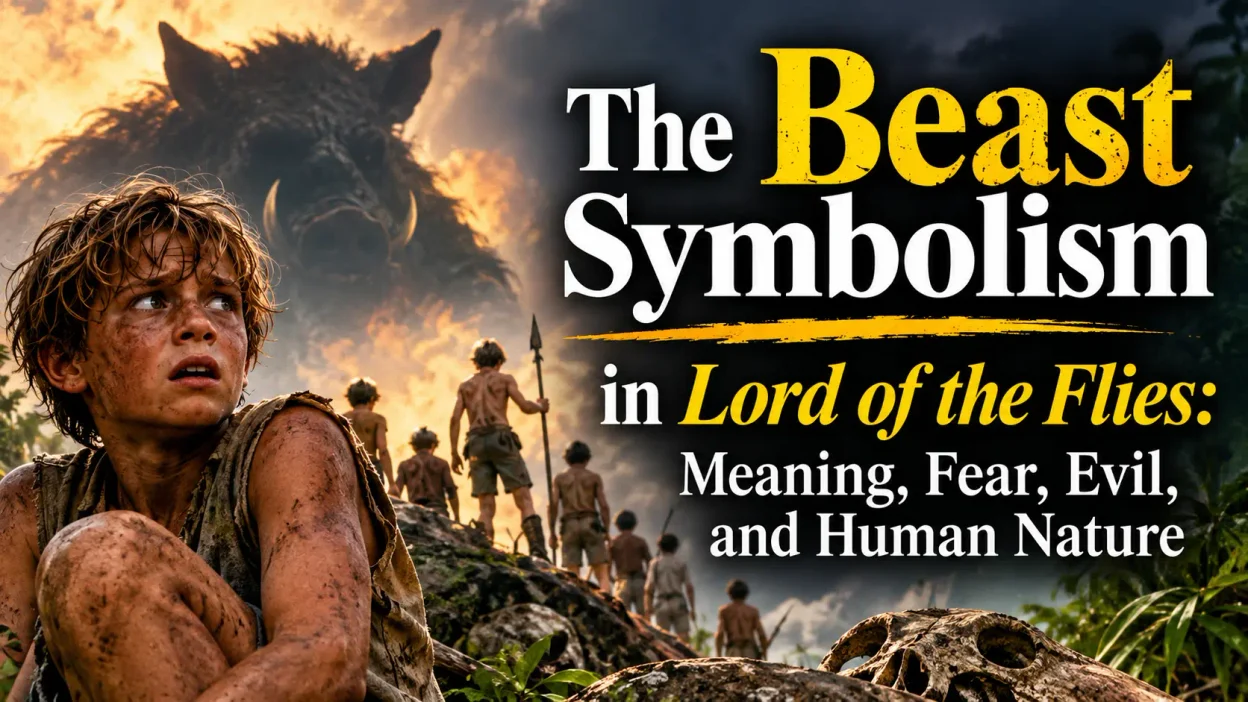
In William Golding’s novel Lord of the Flies, the beast is one of the most important and powerful symbols. At first, the boys stranded on the island believe that a terrifying creature is hiding somewhere in the forest. As their fear grows, the beast becomes an increasingly powerful presence, influencing their decisions, relationships, and behavior.
However, the beast is not simply a mysterious animal or physical threat. It represents something much deeper: the fear, violence, cruelty, and destructive instincts that exist within human beings. Through the boys’ growing belief in the creature, Golding explores how fear can weaken reason, destroy social order, and encourage people to become increasingly savage.
The beast also reveals one of the novel’s central ideas: evil does not always come from an outside force. Sometimes, the greatest danger comes from within human nature itself.
Understanding the beast symbolism in Lord of the Flies helps readers recognize Golding’s criticism of civilization, the fragility of social rules, and the darker side of humanity.
What Does the Beast Symbolize in Lord of the Flies?
The beast primarily symbolizes the darkness within human nature, fear, savagery, violence, and the potential for evil. Although the boys initially imagine it as an external creature, the novel gradually reveals that the real beast is connected to their own instincts and behavior.
The symbol has several important meanings:
- Inner evil: The beast represents the capacity for cruelty and violence within human beings.
- Fear: It reflects the boys’ growing anxiety and their inability to understand what frightens them.
- Savagery: It symbolizes the collapse of civilized behavior and the rise of primitive instincts.
- Violence: The beast represents the destructive behavior that emerges when the boys abandon rules and responsibility.
- The unknown: It reflects humanity’s fear of things that cannot be explained or controlled.
- Loss of innocence: The boys’ belief in the beast marks their gradual movement away from childhood innocence.
Golding uses this symbol to suggest that the greatest threat to society may not be an outside enemy but the darkness people carry within themselves.
1. The Beast Symbolizes the Evil Within Human Nature
One of the most important interpretations of the beast is that it represents the potential for evil inside every human being.
At the beginning of the novel, the boys believe that the creature is something separate from themselves. They imagine it as an animal or monster living in the jungle. However, as the story develops, their own behavior becomes increasingly violent and destructive.
Jack and his hunters gradually abandon the rules that Ralph tries to maintain. Hunting becomes more than a way to find food; it becomes an expression of excitement, aggression, and power.
The boys eventually participate in violence and lose their sense of responsibility toward one another.
Simon is the character who comes closest to understanding the beast’s true meaning. During his encounter with the Lord of the Flies, he recognizes that the beast is not simply a physical creature hiding somewhere on the island. It is connected to the darkness within the boys themselves.
This interpretation supports Golding’s central message: evil is not always imposed on people from outside. It can emerge from human desires, fears, and instincts.
2. The Beast Symbolizes Fear and Psychological Control
Fear is another major meaning of the beast in the novel. The boys become increasingly frightened because they cannot identify or understand the creature they believe inhabits the island.
Their fear grows stronger as they share stories and imagine increasingly terrifying possibilities.
The younger boys, especially the littluns, are among the first to express concerns about the beast. Their anxiety gradually spreads to the older boys, weakening their confidence in the island’s safety.
Fear influences the group in several ways:
- It makes the boys suspicious of their surroundings.
- It encourages them to believe frightening stories without evidence.
- It weakens their ability to think logically.
- It makes them more willing to follow Jack’s promises of protection.
- It creates opportunities for manipulation and control.
Jack uses the boys’ fear to strengthen his authority. By presenting himself as a powerful hunter who can protect them from the beast, he gains influence over the group.
Golding demonstrates that fear can become a form of control. When people are frightened, they may surrender reason and freedom in exchange for the promise of security.
3. The Beast Symbolizes Savagery and the Collapse of Civilization
The beast also represents the savage instincts that emerge when the boys move away from the rules of civilized society.
At first, Ralph tries to establish order through meetings, responsibilities, and the conch shell. These systems are intended to keep the group organized and ensure that everyone has a voice.
However, as the boys become more interested in hunting and following Jack, their commitment to cooperation begins to disappear.
The fear of the beast contributes to this breakdown. Instead of relying on discussion and reason, the boys increasingly turn toward violence, superstition, and group aggression.
Jack’s tribe eventually becomes a community based on intimidation and obedience rather than shared responsibility.
The beast therefore symbolizes the destructive power of unchecked instincts and the fragility of civilization.
Golding suggests that civilized behavior is not guaranteed simply because people live in an organized society. It depends on rules, self-control, empathy, and a willingness to respect others.
4. The Beast Symbolizes the Fear of the Unknown
The boys’ fear of the beast also reflects a broader human fear of the unknown.
They are stranded on an unfamiliar island without adults, clear information, or a reliable understanding of their surroundings. Their isolation makes ordinary sounds and unexplained events seem threatening.
As their imaginations become more active, they begin interpreting uncertainty as evidence of danger.
This fear is especially visible when the boys encounter the dead parachutist. From a distance, the figure appears to move in the wind, and the boys mistake it for the beast.
The incident shows how limited knowledge and fear can combine to create frightening beliefs.
The beast becomes a symbol of everything people cannot explain or control, including:
- Uncertainty about the future
- Fear of unfamiliar environments
- Anxiety about survival
- Misunderstanding and misinformation
- The imagination’s ability to create threats
Golding uses the boys’ reactions to show how easily fear can replace evidence when people are under pressure.
5. The Beast Symbolizes the Loss of Childhood Innocence
At the beginning of Lord of the Flies, the boys are children who expect adventure and freedom. They initially see the island as an exciting place where they can enjoy themselves without adult supervision.
However, their experiences gradually destroy this innocent perspective.
The beast becomes a central part of this transformation. Their growing fear leads to suspicion, violence, and increasingly cruel behavior.
The murder of Simon represents one of the most tragic moments in this loss of innocence. During a violent group ritual, the boys mistake Simon for the beast and attack him.
Their actions reveal how completely fear and collective aggression have overwhelmed their ability to recognize truth and humanity.
The beast therefore symbolizes the disturbing transition from innocence to cruelty.
Golding suggests that childhood does not automatically protect people from violence or destructive instincts. Under certain conditions, even children can participate in terrible acts.
The Lord of the Flies and Its Connection to the Beast
<AsyncImage query=”Lord of the Flies pig head on stick forest dark literary symbolism illustration” aspectRatio=”16:9″ width=”100%”/>
The Lord of the Flies is the pig’s head that Jack’s hunters place on a sharpened stick as an offering to the beast.
It becomes one of the novel’s most disturbing symbols because it represents the relationship between the imagined creature and the boys’ own violent instincts.
When Simon encounters the pig’s head, he experiences a disturbing vision in which the Lord of the Flies seems to speak to him.
The conversation reveals that the beast is not simply an animal hiding in the forest. Its real power comes from the darkness within the boys themselves.
The pig’s head symbolizes:
- The evil within human nature
- The corruption of innocence
- Fear and psychological manipulation
- The connection between savagery and violence
- The destructive instincts that people may struggle to control
The title Lord of the Flies is also connected to the biblical name Beelzebub, traditionally associated with the devil. This connection strengthens the novel’s exploration of evil, temptation, and moral corruption.
Different Forms of the Beast in Lord of the Flies
The beast does not appear in only one form. As the boys’ fears develop, they imagine different versions of the creature.
Each appearance reveals something about their changing psychological and social conditions.
| Form of the Beast | Symbolic Meaning |
|---|---|
| Imagined creature in the forest | Childhood fear and imagination |
| Beast from the sea | Fear of the unknown and uncontrollable nature |
| Dead parachutist | Misunderstanding, uncertainty, and psychological fear |
| The pig’s head | Inner evil, savagery, and corruption |
| Simon’s realization | The truth that the beast exists within human nature |
These different forms demonstrate how the beast develops from an imagined threat into a powerful symbol of the boys’ psychological and moral decline.
Simon’s Understanding of the Beast
<AsyncImage query=”Lord of the Flies Simon boy alone forest sunlight literary illustration” aspectRatio=”16:9″ width=”100%”/>
Simon is the character who understands the beast more clearly than anyone else.
While Ralph and Jack focus on practical survival and leadership, Simon is more thoughtful and sensitive. He spends time alone in the forest and often recognizes truths that other boys overlook.
During his encounter with the Lord of the Flies, Simon realizes that the beast is not an external creature that can simply be hunted or destroyed.
Instead, it represents the darkness within the boys themselves.
His understanding is important because it reveals the novel’s central philosophical message. The beast cannot be defeated by hunting it because it is not a separate animal. It is connected to the human capacity for cruelty and violence.
Tragically, Simon is unable to communicate this truth to the others. When he discovers that the supposed beast is actually a dead parachutist, he rushes to tell the group. However, the frightened boys mistake him for the creature and kill him during their frenzied ritual.
His death demonstrates the devastating consequences of fear, ignorance, and collective violence.
The Beast and the Difference Between Ralph and Jack
The beast also helps reveal the differences between Ralph and Jack.
Both characters respond to the boys’ fear, but they represent opposing approaches to leadership and human behavior.
| Ralph | Jack |
|---|---|
| Tries to maintain order | Encourages hunting and tribal loyalty |
| Values cooperation | Values power and dominance |
| Wants the group to be rescued | Becomes increasingly focused on hunting |
| Relies on discussion and rules | Uses fear and intimidation |
| Represents civilization | Represents savagery |
Ralph recognizes that the group needs organization and practical responsibilities to survive.
Jack, on the other hand, gradually uses the beast as an opportunity to gain authority. He presents hunting as a way to protect the boys and offers them the excitement of belonging to a powerful tribe.
This contrast shows how fear can influence leadership and allow authoritarian behavior to develop.
The Dead Parachutist: The False Beast
<AsyncImage query=”Lord of the Flies dead parachutist silhouette mountain night literary illustration” aspectRatio=”16:9″ width=”100%”/>
The dead parachutist is one of the most important events in the development of the beast symbol.
During the night, a parachutist lands on the island after being killed in an aerial battle. His body becomes caught in the trees, and the movement of the parachute makes the figure appear frightening.
When Sam and Eric see it, they believe they have encountered the beast.
This misunderstanding increases the group’s fear and strengthens their belief that a dangerous creature is living on the island.
The dead parachutist symbolizes:
- The destructive consequences of war
- The confusion created by fear
- The danger of interpreting appearances without evidence
- The influence of the adult world’s violence
- The connection between external conflict and internal savagery
The irony is especially important: the boys fear a creature they imagine to be dangerous, while the actual source of violence is the human behavior developing among them.
How Does the Beast Represent the Theme of Evil?
The beast is closely connected with the novel’s exploration of evil.
At first, the boys assume that evil is something external that can be identified and defeated. They believe that if they find the creature, they can eliminate the danger.
However, the novel gradually challenges this assumption.
The boys themselves become increasingly violent. Jack’s group participates in cruelty, Simon is killed, and Piggy eventually dies during the collapse of the group’s social order.
These events reveal that the real danger is not simply the imagined beast. It is the willingness of human beings to abandon morality and harm others.
Golding uses the beast to question the belief that evil exists only in monsters, enemies, or unfamiliar threats.
Instead, he suggests that every human society must recognize and confront the possibility of violence within itself.
Why Is the Beast Symbolism Important in Lord of the Flies?
The beast is essential to understanding the novel because it connects several major themes into one central image.
It helps Golding explore:
- Human nature: The potential for evil and cruelty exists within ordinary people.
- Fear and manipulation: Fear can influence behavior and make people easier to control.
- Civilization and savagery: Social rules can collapse when people abandon cooperation and responsibility.
- Loss of innocence: The boys gradually become capable of violence and cruelty.
- The unknown: People may create frightening explanations when they cannot understand their surroundings.
- The effects of war: Violence in the adult world is reflected in the boys’ behavior on the island.
The beast is therefore more than a frightening element in the plot. It is the central symbol through which Golding explores the darker possibilities of human behavior.
Frequently Asked Questions About the Beast Symbolism in Lord of the Flies
1. What does the beast symbolize in Lord of the Flies?
The beast symbolizes the evil within human nature, fear, savagery, violence, and the unknown. It represents the destructive instincts that emerge when people abandon social rules and moral responsibility.
2. Is the beast real in Lord of the Flies?
The boys believe the beast is real, but there is no actual supernatural monster on the island. The creature they mistake for the beast is a dead parachutist. Symbolically, the beast represents the darkness within human nature.
3. What does the beast symbolize in relation to human nature?
The beast represents the potential for cruelty, aggression, and evil within ordinary human beings. Golding suggests that civilization does not completely remove these instincts.
4. Why are the boys afraid of the beast?
The boys are frightened because they are isolated, uncertain about their surroundings, and unable to explain mysterious events on the island. Their fear grows through rumors, imagination, and misunderstandings.
5. What does Simon realize about the beast?
Simon realizes that the beast is not an external creature hiding in the forest. It represents the darkness and violent instincts within the boys themselves.
6. How does Jack use the beast to gain power?
Jack uses the boys’ fear by presenting himself as a strong hunter and protector. He promises to defend them against the creature, which helps him attract followers and increase his authority.
7. What does the Lord of the Flies symbolize?
The Lord of the Flies, represented by the pig’s head on a stick, symbolizes inner evil, savagery, and moral corruption. Its conversation with Simon reveals the beast’s connection to human nature.
8. What does the dead parachutist represent?
The dead parachutist represents the destructive influence of war, fear, and misunderstanding. The boys mistake his body for the beast, showing how fear can distort their perception of reality.
9. How does the beast symbolize the loss of innocence?
The boys’ growing fear of the beast contributes to their increasing violence and cruelty. Their actions, particularly Simon’s murder, demonstrate how far they have moved from their original innocence.
10. What is Golding’s main message about the beast?
Golding’s main message is that the greatest threat to humanity may come from within rather than from outside. The beast represents the potential for evil that exists in human nature and can emerge when morality and civilization break down.
Conclusion: The Deeper Meaning of the Beast in Lord of the Flies
The beast symbolism in Lord of the Flies reveals William Golding’s central concern about human nature and the fragile boundary between civilization and savagery. Although the boys initially imagine the beast as a dangerous creature living on the island, its deeper meaning becomes increasingly clear as their own behavior grows violent and destructive.
Through fear, the dead parachutist, the Lord of the Flies, and Simon’s tragic realization, Golding demonstrates that the beast is not simply an external enemy. It represents the darkness, aggression, and cruelty that human beings are capable of expressing.
Ultimately, the novel suggests that rules and social structures alone cannot eliminate evil. Civilization depends on self-control, compassion, reason, and moral responsibility. The beast remains one of literature’s most powerful symbols because it challenges readers to recognize that the greatest dangers may come not from the monsters people fear, but from the darker instincts they refuse to acknowledge.