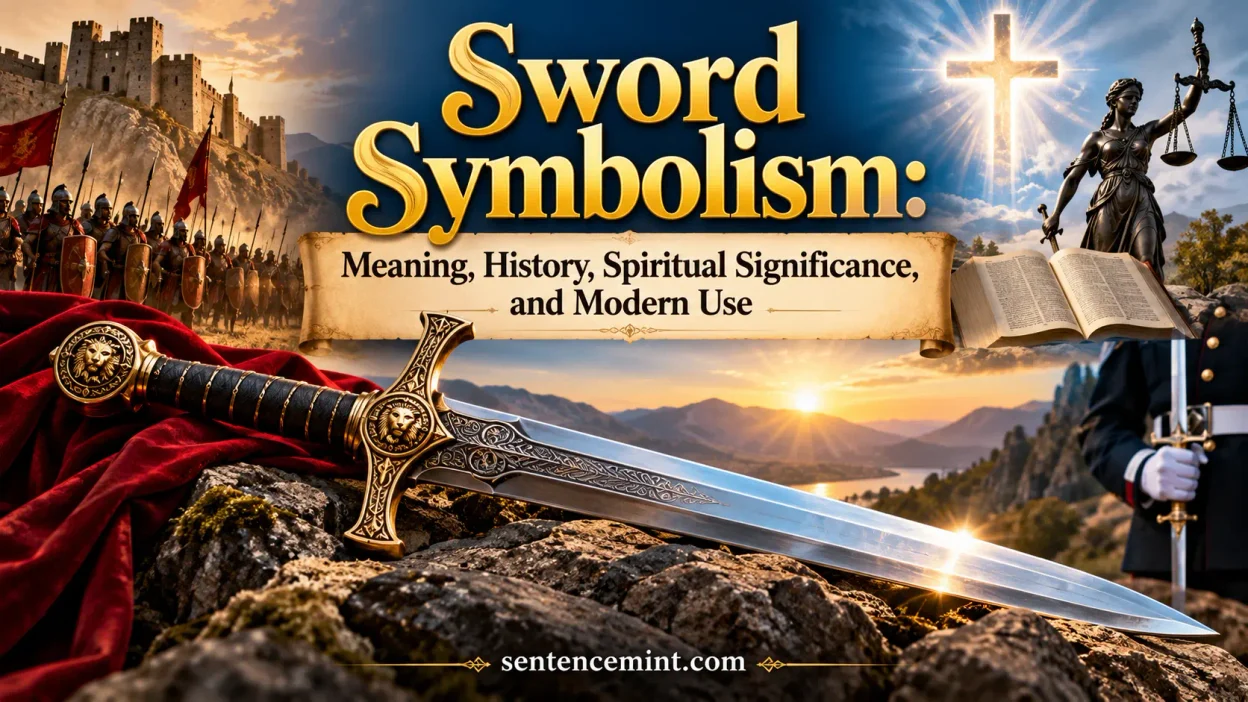
Quick Answer: What Does a Sword Symbolize?
A sword commonly symbolizes courage, strength, justice, protection, authority, honor, and the power to overcome challenges. Throughout history, swords have represented both the ability to defend what matters and the responsibility that comes with power. In spiritual and literary traditions, a sword may also symbolize truth, wisdom, separation, judgment, or personal transformation.
The meaning of a sword depends on its context. A sword held by a guardian may represent protection, while a broken sword can symbolize defeat, peace, or the end of a struggle. A sword appearing in a dream may reflect personal conflict, difficult decisions, boundaries, or a desire to stand up for oneself.
TL;DR: Key Meanings of Sword Symbolism
- Courage: The willingness to face danger and uncertainty.
- Strength: Inner resilience, determination, and personal power.
- Justice: The enforcement of rules, fairness, and accountability.
- Protection: Defending oneself, loved ones, or important beliefs.
- Authority: Leadership, sovereignty, and responsibility.
- Honor: Loyalty, integrity, and commitment to a personal code.
- Truth: Cutting through confusion, deception, or false assumptions.
- Transformation: Ending one phase of life and beginning another.
- Conflict: Struggle, opposition, anger, or difficult choices.
- Peace: A sheathed or broken sword can represent restraint, reconciliation, or the end of violence.
What Is the Symbolism of a Sword?
A sword is one of the most recognizable symbols of power and conflict. Historically, it served as a weapon, a marker of social status, and an object associated with military leadership. Over time, its meaning expanded beyond physical combat into ideas about justice, morality, spirituality, and personal character.
The sword has two important symbolic dimensions. First, it represents the ability to act decisively and defend what is important. Second, it reminds us that power can cause harm when it is used without wisdom or restraint.
This dual meaning makes the sword a powerful symbol in mythology, religion, literature, heraldry, and modern popular culture.
A sword can represent a person’s determination to confront a problem, the courage to speak honestly, or the discipline required to make a difficult decision. It can also symbolize aggression, division, revenge, and the consequences of unchecked ambition.
Its interpretation depends on who carries it, how it is used, and what surrounds it.
1. Sword Symbolism and Courage
One of the strongest associations of a sword is courage. In historical stories and heroic traditions, swords are frequently carried by warriors who must confront danger, defend their communities, or protect people who cannot protect themselves.
Symbolically, courage does not always mean fighting. It can mean facing an uncomfortable truth, standing up to unfair treatment, or continuing through a difficult period.
A sword may represent the courage to:
- Defend personal values even when others disagree.
- Face a challenge rather than avoid it.
- Speak honestly in a difficult situation.
- Protect someone vulnerable.
- Make a necessary decision despite uncertainty.
A sword appearing in artwork may therefore communicate bravery and readiness. It suggests that a person is prepared to confront obstacles instead of allowing fear to control their choices.
2. Sword Symbolism and Strength
The sword also represents strength, but this strength can be physical, emotional, intellectual, or spiritual.
In traditional imagery, a warrior’s sword demonstrates the ability to defend a position. In modern interpretations, the same image can symbolize resilience, self-confidence, discipline, and the capacity to recover after hardship.
A sword may remind someone that strength involves more than dominating others. It can also mean remaining calm under pressure, protecting personal boundaries, and responding thoughtfully to adversity.
Inner Strength and Resilience
A sword in symbolic artwork can represent the determination to keep moving forward. It may be associated with someone who has survived a difficult experience and emerged with a clearer sense of identity.
A polished sword might suggest discipline and readiness, while a damaged sword could represent a struggle that has tested someone’s confidence.
These meanings are interpretive rather than universal, but they illustrate why the sword remains a compelling image of personal strength.
3. Sword Symbolism and Justice
The sword is closely associated with justice, judgment, and the enforcement of law.
In many artistic depictions, figures representing justice carry a sword alongside scales. The scales suggest balance and impartial judgment, while the sword represents the authority to uphold a decision.
This imagery communicates that justice requires both fairness and the ability to act.
A sword can symbolize:
- Accountability for one’s actions.
- The protection of legal rights.
- The defense of fairness.
- The consequences of wrongdoing.
- The responsibility to use authority ethically.
However, a sword does not automatically represent justice. It can also symbolize oppression when power is exercised unfairly. Its meaning depends on whether the force it represents protects people or controls them unjustly.
4. Sword Symbolism and Protection
Throughout history, swords were used to defend people, territory, and communities. This practical role helped establish the sword as a symbol of protection.
In symbolic terms, a sword can represent the willingness to guard something valuable, whether that is family, personal dignity, cultural identity, or deeply held beliefs.
Protection of Personal Boundaries
In contemporary interpretations, a sword may represent the ability to say no, leave an unhealthy situation, or refuse to accept harmful behavior.
It can serve as a reminder that protecting yourself does not necessarily require aggression. Sometimes, protection means establishing clear boundaries, seeking support, or choosing not to engage in a conflict.
The Sword as a Guardian Symbol
In fantasy, mythology, and decorative art, a sword held by a guardian often signifies vigilance. The guardian’s role is not simply to fight but to remain prepared when danger appears.
This symbolism makes swords common in stories about heroes, protectors, defenders, and people entrusted with important responsibilities.
5. Spiritual Symbolism of a Sword
The spiritual meaning of a sword varies across religious, philosophical, and cultural traditions. It may represent discernment, truth, divine authority, spiritual struggle, or the separation of wisdom from confusion.
A sword’s sharp edge provides a useful metaphor for clarity. Just as a blade divides one thing from another, the sword can symbolize the ability to distinguish truth from falsehood or meaningful priorities from distractions.
Spiritual Discernment
A sword may represent the process of recognizing what is beneficial and what is harmful. In this interpretation, it symbolizes thoughtful judgment rather than physical force.
Someone may use sword imagery to express a desire to release misleading beliefs, recognize unhealthy patterns, or make decisions aligned with their values.
Spiritual Struggle
In some religious imagery, swords appear in depictions of spiritual conflict. They can represent the struggle between good and evil, faith and doubt, or discipline and temptation.
These interpretations should be understood within their particular traditions rather than treated as universal spiritual facts.
Transformation and Renewal
A sword can also represent the end of an old chapter. Cutting imagery is often used metaphorically for releasing attachments, breaking destructive patterns, or making a decisive change.
In this sense, the sword symbolizes the courage to leave behind what no longer supports personal growth.
6. Sword Symbolism in Christianity
In Christian texts and artistic traditions, the sword can carry several distinct meanings. Its interpretation depends on the passage or image in which it appears.
One important example is the description of the “sword of the Spirit” in Ephesians 6:17. Within the passage’s imagery of spiritual armor, the sword is associated with the word of God.
Hebrews 4:12 also compares the word of God to a sharp, double-edged sword. In this context, the image emphasizes its penetrating power and ability to reveal the thoughts and intentions of the heart.
Swords can also appear in biblical narratives as literal weapons or symbols of judgment and conflict. Therefore, Christian sword symbolism cannot be reduced to a single meaning.
Common interpretations include:
- Truth: The ability of God’s word to expose what is hidden.
- Spiritual readiness: The preparation to face moral and spiritual challenges.
- Discernment: The distinction between truth and deception.
- Judgment: The consequences of actions within a particular biblical context.
- Conflict: The divisions and struggles described in certain passages.
The specific biblical passage is essential when interpreting a sword in Christian art or writing.
7. Sword Symbolism in Japanese Culture
The Japanese sword, particularly the katana, is strongly associated in popular understanding with the samurai and Japan’s martial history.
The katana’s symbolism is often connected with discipline, skill, responsibility, loyalty, and the warrior ideal. However, these meanings developed across different historical periods and should not be treated as an unchanging set of beliefs shared by every Japanese person.
The sword was also a practical weapon and a status-associated object in particular historical contexts. Its cultural significance extended beyond combat into craftsmanship, ceremony, and artistic representation.
In modern films, anime, games, and literature, the katana often symbolizes:
- Mastery developed through practice.
- Commitment to a personal code.
- Self-control and discipline.
- The burden of responsibility.
- The struggle between duty and individual desire.
A Japanese sword in a story may reveal the character of its owner. A warrior who uses it carefully may be portrayed as disciplined, while someone who uses it recklessly may represent pride or uncontrolled aggression.
8. Sword Symbolism in Mythology and Legends
Swords appear in myths and legends from many parts of the world. They often distinguish heroes from ordinary characters and serve as signs of destiny, authority, or extraordinary ability.
Excalibur and the Idea of Legitimate Leadership
In Arthurian legend, Excalibur is associated with King Arthur and has become a lasting symbol of kingship, heroic identity, and legitimate rule.
Its meaning extends beyond the weapon itself. It represents the responsibilities that accompany leadership and the idea that authority should be connected with worthiness.
The Sword of Damocles
The expression “sword of Damocles” refers to a story in which a sword hangs above Damocles by a single hair, illustrating the danger and insecurity that can accompany power and privilege.
In modern usage, it symbolizes a persistent threat or serious risk that could become a problem at any moment.
Magical and Legendary Swords
In fantasy and folklore, enchanted swords may possess unusual abilities or be connected with a hero’s destiny. They can symbolize the tools, knowledge, or responsibilities required to overcome a great challenge.
Such stories often suggest that possessing power is not enough. The character must also demonstrate judgment, courage, or moral integrity.
9. Sword Symbolism in Different Contexts
A sword’s meaning can change significantly depending on its appearance and condition.
| Sword Image | Common Symbolic Meaning |
|---|---|
| Upright sword | Readiness, authority, courage, or determination |
| Sheathed sword | Restraint, peace, controlled power, or patience |
| Broken sword | Defeat, sacrifice, the end of conflict, or lost authority |
| Double-edged sword | Dual consequences, complexity, or a benefit that carries risks |
| Flaming sword | Powerful protection, judgment, or intense spiritual imagery |
| Rusty sword | Neglected abilities, forgotten responsibilities, or diminished power |
| Sword and shield | Defense, bravery, preparedness, and resilience |
| Crossed swords | Conflict, rivalry, confrontation, or competition |
| Sword pointing downward | Surrender, mourning, restraint, or the conclusion of a struggle |
| Sword in a stone | Worthiness, destiny, leadership, or a difficult challenge |
These are common interpretive associations, not fixed definitions. The same image may communicate different ideas depending on its cultural, religious, or artistic setting.
10. The Symbolism of a Double-Edged Sword
A double-edged sword is especially important in symbolic language because it represents something that has two sides or produces mixed consequences.
The phrase “a double-edged sword” commonly describes a situation, quality, or decision that offers advantages while also creating risks.
For example, ambition can motivate someone to achieve remarkable goals, but excessive ambition can damage relationships or well-being. Similarly, honesty can build trust, but blunt honesty without compassion can hurt people unnecessarily.
The double-edged sword therefore symbolizes the complexity of power and choice.
It can remind us that:
- Every major decision may have consequences.
- A strength can become a weakness when taken too far.
- Power requires responsibility.
- Good intentions do not always produce good outcomes.
- Wisdom involves considering both benefits and risks.
This is one of the sword’s most widely understood modern meanings because it applies to everyday decisions as well as dramatic situations.
11. Sword Symbolism in Dreams
Dreaming about a sword can feel intense, but dreams do not have one universal meaning and should not be treated as reliable predictions of future events.
A sword in a dream may reflect personal concerns, emotional conflict, a need for protection, or the process of making a difficult decision. The dreamer’s experiences and feelings are important when considering possible interpretations.
Dreaming of Holding a Sword
Holding a sword may reflect a desire to feel more confident, prepared, or capable of handling a challenge.
It could also relate to the need to establish boundaries or take responsibility for a decision.
Dreaming of Fighting With a Sword
A sword fight may reflect tension, competition, frustration, or a struggle to defend an opinion. It may be useful to consider whether the dream resembles a conflict occurring in waking life.
The dream does not necessarily mean that physical confrontation will happen.
Dreaming of a Broken Sword
A broken sword may suggest feelings of vulnerability, disappointment, exhaustion, or the belief that a familiar way of solving problems no longer works.
Alternatively, it may symbolize the end of a conflict or the decision to stop fighting over something.
Dreaming of Finding a Sword
Finding a sword could symbolize discovering confidence, recognizing personal strengths, or feeling newly prepared to face a challenge.
Its emotional tone matters: finding a sword with excitement may feel different from discovering one with fear.
Dreaming of Being Threatened by a Sword
This dream may reflect anxiety, pressure, vulnerability, or a situation in which the dreamer feels controlled by someone else.
Rather than assuming it predicts danger, consider whether there are real-life circumstances that are creating stress or insecurity.
12. Sword Symbolism in Literature and Art
Writers and artists use swords to communicate ideas that go beyond violence. A sword can become an extension of a character’s identity, values, ambitions, or internal struggles.
Heroism and Responsibility
A hero’s sword may symbolize the duty to protect others. The weapon becomes meaningful because of the choices its owner makes, not simply because it is powerful.
Moral Conflict
A sword may represent the difficult choice between competing responsibilities. A character might have to decide whether to follow orders, defend a loved one, uphold the law, or act according to personal conscience.
Power and Corruption
In some stories, the sword represents authority that becomes dangerous when separated from ethical judgment. The weapon can reveal a character’s growing arrogance or willingness to harm others to maintain control.
Peace and Reconciliation
A character who puts away a sword may demonstrate restraint, forgiveness, or a decision to pursue peace. This can be as symbolically significant as drawing the weapon.
In art, details such as the sword’s position, condition, and relationship to other objects help establish the intended meaning.
13. Sword Symbolism in Modern Culture
The sword continues to appear in films, television, video games, tattoos, logos, jewelry, and fantasy illustrations.
Its modern meaning often combines traditional associations with personal identity and storytelling.
In Movies and Video Games
Swords commonly symbolize a hero’s journey, training, personal growth, or struggle against a powerful opponent. A special sword may represent a character’s responsibilities or the culmination of years of effort.
In Tattoos
People may choose sword tattoos to represent courage, strength, protection, honor, resilience, or the ability to overcome hardship.
A sword combined with flowers may contrast strength with beauty or express the balance between toughness and sensitivity. A sword wrapped in a snake may suggest transformation, danger, healing, or renewal, depending on the design and the owner’s intended meaning.
A sword tattoo does not have one universal interpretation; personal experience and cultural context matter.
In Logos and Emblems
Swords appear in some institutional emblems, coats of arms, and organizational symbols. They may communicate readiness, authority, heritage, or a commitment to defense.
When paired with scales, a sword may emphasize justice. When paired with a shield, it may emphasize protection and preparedness.
14. What Does a Sword Symbolize Spiritually in Personal Growth?
For personal reflection, a sword can serve as a metaphor for clarity, discipline, courage, and the ability to make difficult choices.
Its sharp edge suggests precision: identifying the real problem instead of becoming distracted by smaller concerns. Its strength suggests resilience, while the responsibility associated with carrying a weapon reminds us to use personal power carefully.
A sword can encourage reflection on several questions:
- Where do I need to show more courage?
- Which boundaries do I need to establish?
- What truth am I avoiding?
- Am I using my influence responsibly?
- Is there a conflict I should address—or one I should stop feeding?
- What habit or situation am I ready to leave behind?
These questions turn the sword from an image of physical force into a symbol of thoughtful action.
The central lesson is that strength and wisdom are most effective when they work together. Courage without judgment can become recklessness, while restraint without courage can become avoidance.
15. Sword Symbolism Compared With Other Weapons
Swords share some symbolic meanings with other weapons, but each object may communicate a different emphasis.
| Symbol | Common Associations | Main Difference |
|---|---|---|
| Sword | Courage, justice, authority, conflict | Often combines personal skill with direct confrontation |
| Shield | Safety, defense, resilience | Emphasizes protection rather than attack |
| Spear | Readiness, pursuit, focused action | Often represents reaching toward or confronting a target |
| Bow and arrow | Focus, intention, precision | Can symbolize directing effort toward a specific goal |
| Dagger | Secrecy, close conflict, betrayal | May suggest hidden danger or personal confrontation |
| Axe | Strength, decisive action, destruction | Often emphasizes force, cutting, or the removal of obstacles |
These distinctions are broad symbolic tendencies rather than universal rules. In a particular myth or artwork, any weapon may carry a more specific meaning.
16. Is a Sword a Positive or Negative Symbol?
A sword can be either positive or negative, depending on its context.
Positive interpretations include courage, protection, fairness, discipline, and the willingness to defend vulnerable people. In these contexts, the sword represents strength guided by purpose.
Negative interpretations include aggression, revenge, intimidation, domination, and destructive conflict. A sword may become a warning about what happens when power is used without empathy or restraint.
Some interpretations combine both sides. A double-edged sword, for instance, emphasizes that a valuable quality can carry risks. A warrior’s sword may symbolize both the ability to protect and the responsibility to avoid unnecessary harm.
Rather than labeling every sword image as good or bad, consider how the sword is used and what values the surrounding story promotes.
17. How to Interpret Sword Symbolism in Everyday Life
If a sword catches your attention in a dream, book, artwork, or personal experience, start by considering the context rather than relying on a single symbolic definition.
Look at the sword’s condition. Is it polished, rusty, broken, sheathed, or drawn? These details may suggest readiness, neglect, vulnerability, or restraint.
Consider who holds it. A protector, ruler, aggressor, or uncertain hero can give the same object a very different meaning.
Notice the surrounding symbols. A sword with scales may emphasize justice; a sword with a shield may emphasize defense; a sword with flowers may express a contrast between strength and gentleness.
Reflect on your emotional response. Did the image make you feel confident, afraid, peaceful, or curious? Your reaction can help identify which associations feel relevant to your own circumstances.
Connect the symbol to real-life questions. Ask whether it relates to a decision, a boundary, a challenge, or a responsibility you are currently considering.
This approach allows symbolic interpretation to support reflection without treating it as a guaranteed prediction or a universal spiritual rule.
Frequently Asked Questions About Sword Symbolism
1. What is the main meaning of sword symbolism?
Sword symbolism most commonly represents courage, strength, justice, protection, authority, and honor. It can also symbolize conflict, judgment, truth, and the responsibility that comes with power.
2. What does a sword symbolize spiritually?
Spiritually, a sword may represent discernment, truth, courage, protection, or the struggle to overcome harmful patterns. Its meaning varies across traditions and depends on the context in which it appears.
3. What does a sword symbolize in the Bible?
In the Bible, a sword may represent a literal weapon, judgment, conflict, or spiritual truth. Ephesians 6:17 uses the image of the sword of the Spirit in connection with the word of God, while Hebrews 4:12 uses a double-edged sword as a metaphor for its penetrating power.
4. What does a sword symbolize in a dream?
A sword in a dream may reflect confidence, conflict, personal boundaries, difficult decisions, or a desire for protection. Dreams are subjective, so their meanings depend on personal experiences and emotions rather than a fixed interpretation.
5. What does a broken sword symbolize?
A broken sword may represent defeat, lost confidence, sacrifice, the end of a struggle, or a change in how someone approaches a problem. The meaning depends on the story or situation.
6. What does a double-edged sword symbolize?
A double-edged sword symbolizes two-sided consequences. It is commonly used to describe something that provides benefits but also creates risks or disadvantages.
7. What does a sword symbolize in Japanese culture?
The Japanese sword, especially the katana, is associated with martial history, craftsmanship, and the samurai. In modern symbolic portrayals, it often represents discipline, skill, loyalty, and responsibility, although meanings vary by historical and cultural context.
8. What does a sword symbolize in love?
In romantic or personal symbolism, a sword may represent loyalty, protection, commitment, or the courage to defend a relationship. It can also suggest conflict or the need to establish healthy boundaries.
9. What does a sword tattoo mean?
A sword tattoo may symbolize courage, resilience, honor, justice, protection, or overcoming adversity. Additional elements, such as flowers, shields, or snakes, can influence the design’s intended meaning.
10. Is a sword a symbol of power?
Yes. Swords have historically been associated with military ability, status, authority, and leadership. Symbolically, they can represent personal power, but they also raise questions about responsibility and ethical use.
11. What does a sheathed sword symbolize?
A sheathed sword may represent restraint, peace, patience, or controlled strength. It can suggest that a person has the ability to act but chooses not to use force unnecessarily.
12. What does a sword and shield symbolize together?
A sword and shield commonly symbolize balanced strength: the ability to act and the ability to protect. Together, they can represent preparedness, bravery, defense, and responsible use of power.
Conclusion: The Enduring Meaning of Sword Symbolism
Sword symbolism carries a rich combination of meanings shaped by history, mythology, religion, art, and contemporary culture. It can represent courage, justice, protection, strength, honor, truth, and authority, while also warning about aggression, conflict, and the misuse of power.
The sword’s meaning often depends on how it is presented. A drawn sword may communicate readiness or confrontation, while a sheathed sword can suggest restraint. A broken sword may signify defeat or the end of a struggle, and a legendary sword may represent leadership or a demanding responsibility.
Ultimately, the sword is more than a symbol of combat. It is a reminder that true strength involves not only the ability to act, but also the wisdom to decide when and how to act. When interpreted in its proper context, sword symbolism offers a meaningful way to explore courage, personal boundaries, justice, and the responsible use of power.