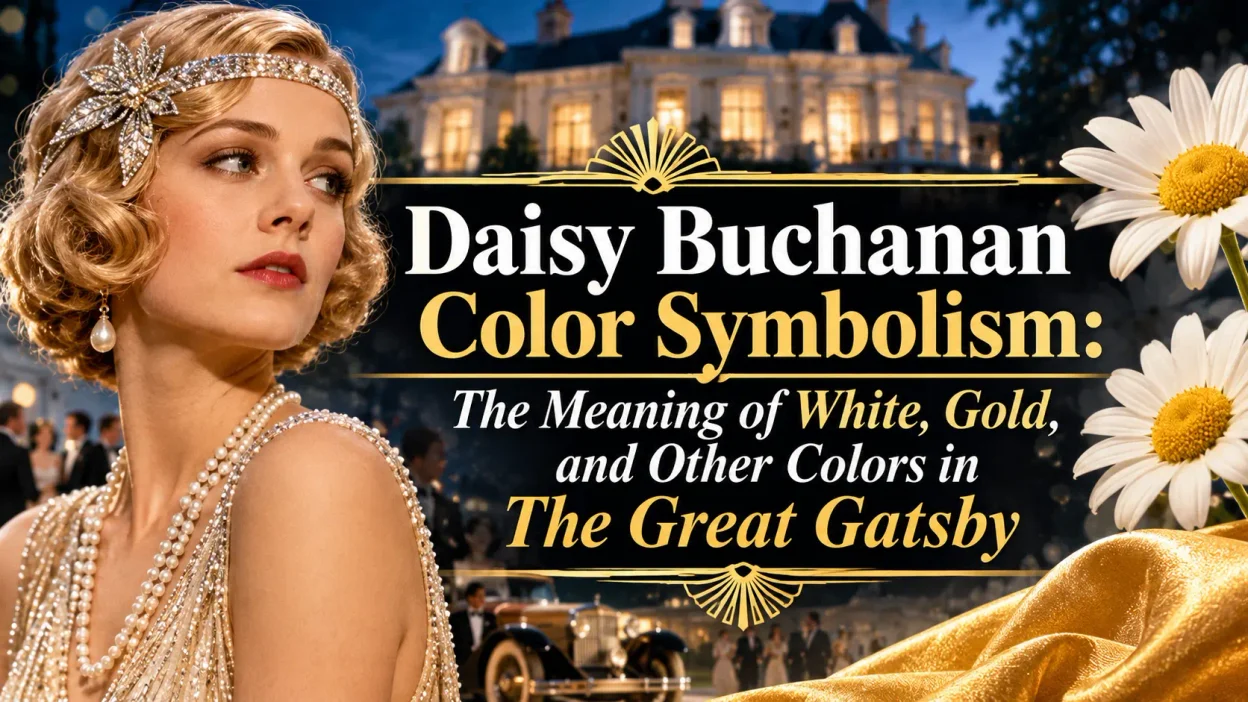
In F. Scott Fitzgerald’s The Great Gatsby, color plays an important role in revealing characters, relationships, social class, and hidden meanings. One of the most interesting characters to explore through color symbolism is Daisy Buchanan.
Daisy is presented as beautiful, charming, wealthy, and seemingly innocent. However, beneath her elegant appearance lies a more complicated personality shaped by privilege, insecurity, romantic desire, and social expectations. Fitzgerald uses colors associated with Daisy to highlight the contrast between her public image and her private reality.
The colors white and gold are especially important when interpreting Daisy’s character. White connects her with beauty, innocence, elegance, and social refinement, while gold suggests wealth, luxury, privilege, and material comfort. Other colors, including yellow, green, and blue, contribute to the novel’s broader symbolic world and help readers understand the society Daisy represents.
Understanding Daisy Buchanan color symbolism reveals how Fitzgerald uses visual details to question the relationship between appearance, morality, wealth, and happiness.
What Does Daisy Buchanan Symbolize?
Daisy Buchanan symbolizes beauty, wealth, privilege, romantic desire, and the attractive but morally complicated world of the American upper class.
She represents the lifestyle Gatsby desperately wants to enter. Her beauty and social position make her appear almost dreamlike, but her decisions reveal the limitations of that idealized image.
Daisy also symbolizes the difference between appearance and reality. Although she is frequently associated with elegance and innocence, she benefits from wealth and social protection even when her actions hurt other people.
Her character is therefore connected to several important themes:
- Wealth and social status
- Beauty and femininity
- Innocence and moral ambiguity
- Romantic desire and disappointment
- Materialism and privilege
- The illusion of the American Dream
1. White Symbolism: Innocence, Beauty, and Social Elegance
White is one of the most significant colors associated with Daisy Buchanan. Throughout the novel, white clothing and imagery contribute to her presentation as a graceful, attractive, and seemingly innocent woman.
White as a Symbol of Innocence
Traditionally, white is associated with purity, innocence, and goodness. Daisy’s connection with white helps create an impression of delicacy and emotional innocence.
When Nick first encounters Daisy and Jordan Baker at the Buchanan home, their white clothing contributes to the room’s light, airy, and elegant atmosphere.
However, this symbolism is complicated. Daisy’s outward appearance does not necessarily reflect her moral character. Her decisions and treatment of others reveal that innocence is partly an image created by her privileged environment.
White as a Symbol of Beauty and Femininity
White also emphasizes Daisy’s beauty and fashionable appearance.
Her clothing and surroundings help present her as an idealized figure in Gatsby’s imagination. She seems graceful, desirable, and almost unreal.
For Gatsby, Daisy represents more than a romantic partner. She becomes a symbol of the perfect life he hopes to achieve.
White as a Symbol of Emotional Distance
White can also suggest emptiness or emotional detachment when interpreted in the context of Daisy’s character.
Although she appears charming and affectionate, she often avoids taking responsibility for difficult situations. Her privileged lifestyle allows her to remain protected from consequences that affect others.
This contrast makes white an important part of Fitzgerald’s exploration of appearance versus reality.
2. Gold Symbolism: Wealth, Luxury, and Privilege
Gold is strongly connected with the wealthy world Daisy inhabits. It represents material success, social status, luxury, and the attractive lifestyle that separates the upper class from ordinary people.
Gold as a Symbol of Wealth
Daisy comes from a wealthy background and is married to Tom Buchanan, whose family possesses considerable financial and social power.
Gold represents the comfortable world in which she lives. Her lifestyle is surrounded by expensive possessions, fashionable clothing, elegant homes, and social privilege.
Gold as a Symbol of Gatsby’s Dream
Gatsby’s love for Daisy is closely connected to his desire for wealth and social acceptance.
He believes that becoming rich will allow him to recreate the past and win Daisy’s affection. In this sense, Daisy becomes associated with the golden world of wealth and opportunity that Gatsby wants to possess.
However, the novel reveals that money alone cannot guarantee love or acceptance into an established social class.
Gold as a Symbol of Materialism
Gold also suggests the influence of material possessions on Daisy’s choices.
Her attachment to security, comfort, and social position makes it difficult for her to leave the life she already has.
Through Daisy, Fitzgerald explores how wealth can become more important than emotional honesty or personal responsibility.
3. Yellow Symbolism: Wealth, Corruption, and Moral Ambiguity
Yellow is an important color throughout The Great Gatsby. It is closely connected with wealth, display, luxury, and the moral problems hidden beneath the glamour of the wealthy world.
Yellow and gold can overlap in their symbolic associations, but they are not always identical. Gold often suggests prestige and luxury, while yellow can carry more complicated meanings, including artificial glamour, corruption, and carelessness.
Yellow as a Symbol of Wealth and Display
Gatsby’s yellow car is one of the novel’s most recognizable images. It represents the extravagant lifestyle and public display of wealth associated with his world.
Although the car belongs to Gatsby rather than Daisy, it becomes connected to her story through the accident that leads to Myrtle Wilson’s death.
Yellow as a Symbol of Carelessness
Daisy’s role in the accident reveals the dangerous consequences of privilege and irresponsibility.
After Myrtle is killed, Daisy does not accept public responsibility for what happened. Gatsby protects her, while she retreats into the security of her marriage and wealth.
The yellow symbolism surrounding the accident therefore contributes to the novel’s criticism of a society in which money can protect people from consequences.
Yellow and the Corruption of the American Dream
The wealthy world may appear glamorous, but Fitzgerald gradually reveals its moral emptiness.
Daisy’s association with this world shows how beauty, money, and social status can hide selfishness and irresponsibility.
4. Green Symbolism: Hope, Desire, and Gatsby’s Dream of Daisy
Green is most famously associated with the green light at the end of Daisy’s dock.
Although the green light is not a color that belongs exclusively to Daisy, it becomes one of the most important symbols connected with Gatsby’s feelings for her.
Green as a Symbol of Hope
Gatsby looks toward the green light because it represents his hope of being reunited with Daisy.
He believes that the future can bring back the happiness he associates with their earlier relationship.
Green as a Symbol of Desire
The green light also represents Gatsby’s longing for something he cannot fully possess.
Daisy becomes part of a larger dream involving love, wealth, social acceptance, and the possibility of recreating the past.
Green as a Symbol of the American Dream
The green light extends beyond Gatsby’s romantic ambitions. It represents the desire to achieve an ideal future, even when that future remains out of reach.
Through this symbol, Fitzgerald connects Daisy’s character with the larger themes of ambition, desire, and disappointment.
5. Blue Symbolism: Romance, Dreaminess, and Illusion
Blue appears in the novel’s broader imagery and can be interpreted in connection with the dreamlike atmosphere surrounding Gatsby’s world.
Its possible associations include emotional distance, fantasy, sadness, and the difference between imagination and reality.
Blue as a Symbol of Dreaminess
Gatsby idealizes Daisy and imagines her as the center of a perfect romantic future.
The dreamy atmosphere associated with blue can help readers interpret the gap between the woman Gatsby remembers and the real person Daisy has become.
Blue as a Symbol of Emotional Distance
Daisy and Gatsby share an emotional connection, but they do not experience the relationship in exactly the same way.
Gatsby’s expectations are shaped by years of longing, while Daisy is more concerned with the life and security she already possesses.
Blue can therefore be used as an interpretive symbol of the emotional distance between romantic fantasy and reality.
Note: Blue is not as firmly established as a personal color symbol for Daisy as white is. Its meaning is better understood through the novel’s wider imagery.
6. Daisy’s White Dresses: Appearance, Status, and Femininity
Daisy’s clothing contributes significantly to how readers understand her character.
Her white dresses help establish her as an elegant and fashionable woman from a wealthy social background.
Fashion and Social Identity
In the 1920s setting, clothing communicates social position and personal identity.
Daisy’s fashionable appearance reflects the expectations and privileges of her social class. Her clothing helps distinguish her from characters who do not enjoy the same level of wealth.
Beauty as an Illusion
Gatsby remembers Daisy as an almost perfect woman. Her beautiful appearance strengthens his idealized image of her.
However, the story gradually reveals that Daisy is not the flawless romantic figure Gatsby imagines.
Her outward beauty contrasts with the emotional and moral complications of her actions.
7. Daisy’s Voice Symbolism: Wealth, Charm, and Social Power
Although it is not a color, Daisy’s voice is one of the novel’s most important symbols.
Nick famously describes her voice as full of money. This observation connects her personality with wealth, privilege, and social status.
A Voice That Represents Money
Daisy’s voice sounds attractive and captivating to Gatsby. However, Nick’s description reveals that its appeal is connected to the wealth and security surrounding her.
Her voice represents the lifestyle Gatsby desires as much as it represents Daisy herself.
Charm and Influence
Daisy’s charm gives her a certain kind of social power. She can attract attention and influence how others perceive her.
However, this charm does not necessarily lead to emotional honesty or responsibility.
The Connection Between Beauty and Wealth
Through Daisy’s voice, Fitzgerald shows that wealth can influence how people experience beauty and attraction.
Gatsby’s fascination with Daisy is therefore connected to both romantic love and the social world she represents.
8. Daisy Buchanan and the Difference Between Appearance and Reality
One of the central ideas behind Daisy’s symbolism is the contrast between how she appears and who she really is.
Her elegant clothing, beautiful surroundings, and charming personality create an impression of innocence and perfection.
However, her actions reveal a more complicated character.
The Image of an Ideal Woman
Gatsby sees Daisy as the woman who can complete his dream. He remembers their past and imagines that their relationship can return to its earlier perfection.
The Reality of Daisy’s Choices
Daisy does not fully match Gatsby’s expectations. She is uncertain, influenced by wealth and security, and unwilling to abandon her established lifestyle.
Her decision to remain with Tom reveals the limitations of Gatsby’s romantic ideal.
Fitzgerald’s Criticism
Through Daisy, Fitzgerald questions the idea that beauty and wealth automatically represent goodness or happiness.
Her character demonstrates how an attractive public image can hide selfishness, fear, and moral weakness.
9. Daisy Buchanan Color Symbolism and the American Dream
Daisy is closely connected to the American Dream because she represents the wealthy lifestyle Gatsby believes will make him happy.
For Gatsby, winning Daisy means more than gaining romantic love. It also means achieving the social position he has wanted for years.
Daisy as a Symbol of Success
Her wealth, family background, and social connections make her appear to represent everything Gatsby wants.
He believes that becoming wealthy can bring him closer to her world.
The Limits of Money
Despite his wealth, Gatsby cannot fully enter Daisy’s established social class.
His money does not erase the differences between inherited privilege and newly acquired wealth.
The Failure of an Idealized Dream
Gatsby’s dream fails partly because he idealizes Daisy and expects her to represent a perfect future.
Through this relationship, Fitzgerald suggests that material success cannot necessarily deliver love, happiness, or personal fulfillment.
10. Main Colors Associated With Daisy Buchanan
The following table summarizes the main color interpretations connected with Daisy and the wider symbolism of The Great Gatsby.
| Color | Symbolic Meaning | Connection to Daisy |
|---|---|---|
| White | Innocence, beauty, elegance | Her appearance and idealized image |
| Gold | Wealth, luxury, privilege | Her social class and material comfort |
| Yellow | Glamour, corruption, carelessness | The wider wealthy world and the accident involving Myrtle |
| Green | Hope, desire, ambition | Gatsby’s longing for Daisy |
| Blue | Dreaminess, distance, sadness | An interpretive connection to romantic illusion |
These meanings are interpretations of Fitzgerald’s imagery rather than a fixed color code. The significance of a color depends on its context in the novel.
Frequently Asked Questions (FAQs)
1. What does white symbolize for Daisy Buchanan?
White symbolizes innocence, beauty, elegance, and social refinement. It reflects Daisy’s attractive public image, although her actions reveal that her appearance does not always match her moral character.
2. Why is Daisy associated with the color white?
Daisy is associated with white through her clothing and the elegant atmosphere surrounding her first appearance in the novel. The color helps present her as graceful, wealthy, and seemingly innocent.
3. What does gold symbolize in relation to Daisy?
Gold symbolizes wealth, luxury, privilege, and material comfort. Daisy’s wealthy background makes her part of the glamorous social world that Gatsby hopes to enter.
4. How is yellow connected to Daisy Buchanan?
Yellow is associated with the novel’s wider imagery of wealth, glamour, and moral corruption. Gatsby’s yellow car becomes connected to Daisy through the accident that kills Myrtle Wilson.
5. What does the green light symbolize for Daisy?
The green light represents Gatsby’s hope and longing for Daisy. It also symbolizes his larger dream of achieving love, wealth, and an ideal future.
6. Does Daisy represent the American Dream?
Daisy represents the attractive lifestyle and social success that Gatsby associates with the American Dream. However, her character also reveals the limitations of pursuing happiness through wealth and status.
7. How does Daisy’s clothing reflect her personality?
Her fashionable clothing reflects beauty, wealth, femininity, and social status. It also contributes to the idealized image Gatsby creates of her.
8. What does Daisy’s voice symbolize?
Daisy’s voice symbolizes wealth, charm, and social privilege. Nick’s description of it as full of money connects her attractiveness with the security and luxury of her background.
9. Is Daisy Buchanan innocent in The Great Gatsby?
Daisy is presented with an appearance of innocence and charm, but her actions complicate that image. Her involvement in Myrtle’s death and her failure to accept responsibility reveal her moral ambiguity.
10. What is the deeper meaning of Daisy Buchanan’s character?
Daisy represents the relationship between beauty, wealth, privilege, and moral responsibility. Her character shows how people can become attached to comfort and status even when their choices hurt others.
Conclusion
Daisy Buchanan’s color symbolism reveals the complicated relationship between beauty, wealth, innocence, and privilege in The Great Gatsby. White reflects her elegant and seemingly innocent image, while gold represents the luxury and social status that define her world. Yellow contributes to the novel’s criticism of wealth and carelessness, and green represents Gatsby’s longing for the future he imagines with her.
Through Daisy, F. Scott Fitzgerald explores the difference between appearance and reality. She seems to represent an ideal romantic dream, but her choices reveal the limitations of that dream.
Ultimately, Daisy is more than a beautiful and wealthy character. She symbolizes a world in which money can create comfort and protection but cannot guarantee love, honesty, or happiness.