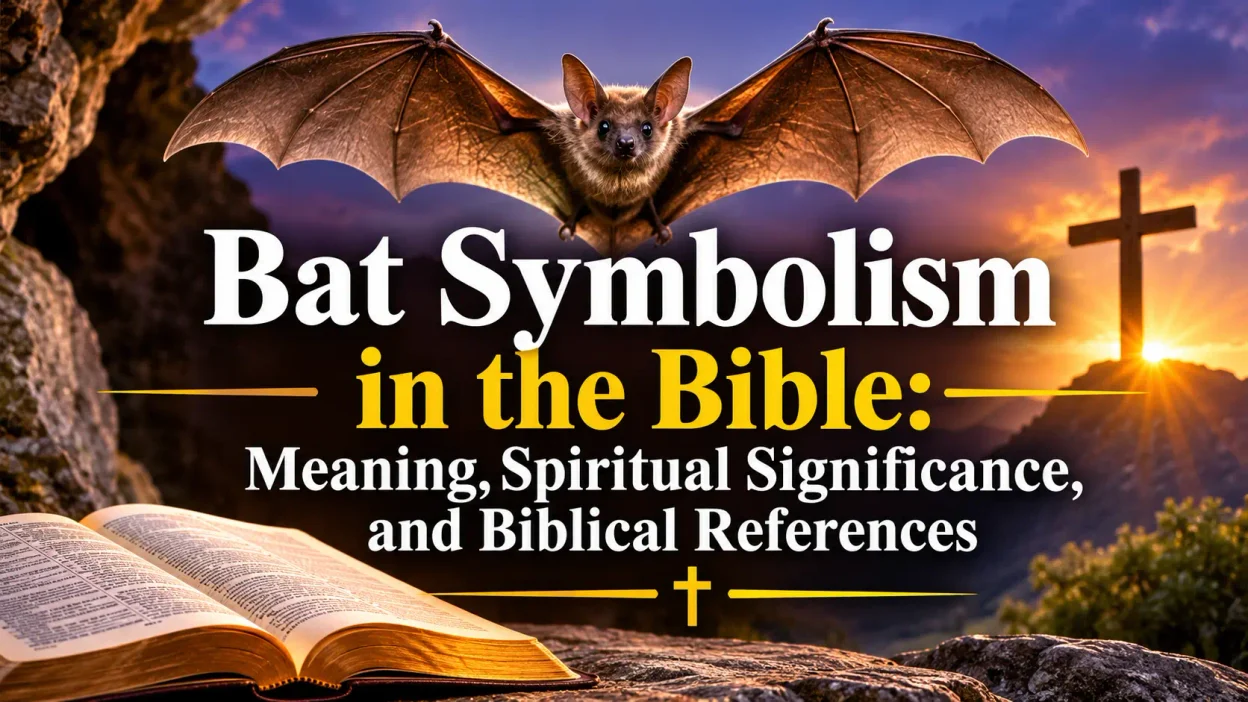
Bat symbolism in the Bible is closely connected to themes of uncleanness, darkness, and spiritual separation. Unlike some modern interpretations that associate bats with transformation, intuition, or mystery, the Bible mentions bats primarily in the context of animals considered unclean under Old Testament dietary laws.
Bats appear in passages that discuss creatures the Israelites were instructed not to eat. Their presence in these lists provides insight into biblical ideas about purity, obedience, and the distinction between clean and unclean animals.
Although the Bible does not provide an extensive symbolic explanation of bats, their appearances can encourage reflection on spiritual discipline, discernment, and faithfulness to God’s instructions.
What Do Bats Symbolize in the Bible?
In biblical context, bats are primarily associated with uncleanness and separation from what was considered holy under the Old Testament law.
Their symbolism can be understood through several themes:
- Uncleanness: Bats are listed among animals that were not permitted as food under Israelite dietary laws.
- Spiritual separation: Their inclusion in lists of unclean creatures illustrates the distinction between clean and unclean.
- Darkness: Because bats are nocturnal, readers may connect them symbolically with darkness, although the Bible does not explicitly assign this meaning to bats.
- Discernment: Their biblical mention encourages readers to understand and follow spiritual instructions.
- Obedience: The dietary laws demonstrate the importance of following God’s commandments within the covenant given to Israel.
These are interpretations drawn from the biblical context, not a list of meanings explicitly assigned to bats by Scripture.
Biblical References to Bats
The Bible mentions bats in several passages, particularly in the Old Testament. Two important references appear in Leviticus and Deuteronomy.
1. Leviticus 11:19
Leviticus 11 describes animals that the Israelites were instructed to regard as unclean. The bat appears in a list of flying creatures that were not to be eaten.
This passage establishes the bat’s place within the dietary restrictions given to ancient Israel.
Symbolic meaning: The reference emphasizes obedience, ritual purity, and the distinction between permitted and forbidden foods.
2. Deuteronomy 14:18
Deuteronomy repeats many of the dietary instructions found in Leviticus. Bats are again included among the birds and flying creatures that the Israelites were not permitted to eat.
The repetition reinforces the importance of following the dietary laws within the covenant community.
Symbolic meaning: This passage can be understood as a reminder of faithfulness, discipline, and respect for God’s instructions.
3. Isaiah 2:20
Isaiah 2:20 describes a future moment when people will throw away their idols of silver and gold to moles and bats.
The passage appears within a broader warning about human pride, false worship, and the coming judgment of God.
Symbolic meaning: The bat appears in a setting associated with the rejection of idols and the humiliation of objects people once valued. It can therefore be discussed in connection with the abandonment of false worship, although the bat itself is not identified as an idol or evil creature.
Spiritual Meanings Associated With Bats in the Bible
The Bible does not give bats a detailed spiritual symbolism. However, their appearances and the surrounding passages offer several themes for reflection.
1. Uncleanness and Purity
The clearest biblical association of bats is with uncleanness. In Leviticus 11 and Deuteronomy 14, bats are included among creatures that the Israelites were forbidden to eat.
In this context, uncleanness refers to the ritual and dietary categories established by the Mosaic Law. It should not automatically be understood as a statement that bats are morally evil.
Spiritual lesson: The passages encourage readers to consider the importance of purity and obedience within their relationship with God.
2. Darkness and Hidden Things
Bats are naturally active at night, which makes darkness a common association in modern symbolic interpretations.
The Bible frequently uses darkness as an image for ignorance, wrongdoing, or separation from God’s light. However, it does not specifically state that bats represent spiritual darkness.
Spiritual lesson: Readers may use the image of a nocturnal creature as a reminder to seek truth, wisdom, and spiritual understanding rather than remain in confusion.
3. Rejection of Idolatry
Isaiah 2:20 describes people throwing their idols to moles and bats when facing the judgment of God.
The central message of this passage is not about bats themselves. It is about the worthlessness of idols when compared with God’s power.
Spiritual lesson: The passage encourages believers to turn away from false sources of security and place their trust in God.
4. Obedience to God’s Instructions
The dietary references in Leviticus and Deuteronomy demonstrate how the Israelites were expected to follow the commandments given to them.
Bats are part of these instructions because they belong to the category of creatures that were not to be eaten.
Spiritual lesson: Faithfulness involves taking spiritual guidance seriously and living according to one’s religious commitments.
5. Discernment Between What Is Clean and Unclean
The Old Testament dietary laws distinguished between clean and unclean animals. These categories were part of Israel’s religious identity and covenant responsibilities.
The bat’s inclusion in the unclean category illustrates the importance of understanding these distinctions within their original biblical setting.
Spiritual lesson: Discernment helps believers distinguish between choices that support their faith and those that conflict with their values.
Why Were Bats Considered Unclean in the Bible?
Bats were classified among the creatures that Israelites were forbidden to eat under the Old Testament dietary laws.
Leviticus 11 and Deuteronomy 14 contain instructions about clean and unclean animals. These rules helped establish religious practices and boundaries for the people of Israel.
It is important to understand that the biblical classification was a religious and dietary distinction. It does not mean that bats were considered demons, symbols of Satan, or inherently evil animals.
Modern readers should also recognize that these dietary instructions belonged to the covenant law given to ancient Israel. Different Jewish and Christian traditions understand their continuing application in different ways.
Bat Symbolism in Isaiah 2:20
Isaiah 2:20 is especially interesting because it mentions bats in a passage about idols.
The verse describes people abandoning their silver and gold idols and throwing them to moles and bats. This imagery communicates the collapse of human pride and the rejection of false gods.
The surrounding chapter warns against arrogance and the worship of things created by human hands.
The bat’s role in this passage is contextual rather than independently symbolic. It appears as part of an image of abandoned idols and the humiliation of objects that people once treated as valuable.
Key message: Material possessions and false sources of worship cannot provide lasting security or replace devotion to God.
Is Seeing a Bat a Sign From God?
The Bible does not teach that seeing a bat is automatically a sign, warning, blessing, or message from God.
Some modern spiritual interpretations associate bats with change, mystery, or hidden knowledge. These interpretations are not established biblical teachings.
If someone sees a bat, there is no biblical reason to assume that something bad will happen or that the animal carries a supernatural warning.
A balanced Christian approach is to focus on Scripture, prayer, wisdom, and personal faith rather than treating ordinary animal encounters as definite predictions.
What Does a Bat in a Dream Mean Biblically?
The Bible does not provide a specific interpretation for dreaming about bats. Therefore, there is no universally established biblical meaning for this dream.
Some people may interpret a bat dream as a reminder to reflect on:
- Spiritual awareness: Consider whether you need greater clarity in an important area of life.
- Discernment: Think carefully about decisions and influences around you.
- Faith and trust: Reflect on whether fear or uncertainty is affecting your spiritual life.
- False priorities: Consider whether material things have become more important than your faith.
These are personal reflections, not biblical predictions. A dream about a bat does not automatically indicate danger, evil, or an upcoming event.
Bat Symbolism in Christianity
Christian interpretations of bats generally begin with their references in the Old Testament.
Some common themes include:
| Theme | Biblical connection |
|---|---|
| Uncleanness | Bats appear in Old Testament lists of forbidden foods. |
| Purity | The dietary laws distinguish clean and unclean creatures. |
| Obedience | Israel was instructed to follow God’s commandments. |
| Idolatry | Isaiah mentions bats in a passage about abandoning idols. |
| Discernment | The biblical distinctions encourage careful spiritual understanding. |
| Humility | Isaiah’s broader message challenges human pride and false security. |
Christian traditions may differ in how they interpret Old Testament dietary laws. However, the biblical references themselves do not describe bats as demonic creatures.
Are Bats Evil According to the Bible?
No. The Bible does not directly describe bats as evil or demonic animals.
Their classification as unclean in Leviticus and Deuteronomy concerns dietary restrictions under the Mosaic Law. It is not a declaration that bats are morally wicked.
Similarly, Isaiah 2:20 uses bats within an image of abandoned idols. The passage criticizes idolatry, not the existence of bats.
This distinction is important because popular folklore sometimes associates bats with vampires, witchcraft, and evil spirits. Those ideas should not be confused with the actual biblical references.
Lessons Christians Can Learn From Bat References
Although bats receive limited attention in Scripture, the passages in which they appear offer several meaningful lessons.
Follow God’s Guidance
The dietary laws remind readers that obedience was an important part of Israel’s covenant relationship with God.
Avoid False Worship
Isaiah 2:20 encourages people to abandon idols and recognize that material objects cannot replace God.
Seek Spiritual Understanding
Biblical teachings about clean and unclean creatures encourage readers to understand the original context of Scripture instead of relying on assumptions.
Do Not Judge Creation Through Superstition
The Bible does not teach that bats are inherently evil. Christians can distinguish biblical teachings from cultural fears and folklore.
Focus on Faith Rather Than Fear
An encounter with a bat does not need to create anxiety. Scripture offers no basis for treating every animal sighting as a supernatural warning.
Bat Symbolism in the Bible vs. Modern Spiritual Interpretations
Modern symbolism often gives bats meanings that differ from their biblical context.
| Biblical context | Modern spiritual interpretation |
|---|---|
| Unclean animal under Old Testament dietary law | Transformation and personal change |
| Mentioned in a passage about abandoned idols | Letting go of the past |
| Associated with dietary distinctions | Mystery and intuition |
| Appears in a nocturnal setting | Exploring hidden feelings |
| No specific biblical meaning of good luck | Sometimes associated with good fortune |
These modern meanings may be meaningful to individuals, but they should not be presented as direct teachings of the Bible.
Frequently Asked Questions
1. What does a bat symbolize in the Bible?
A bat is primarily associated with uncleanness in the Bible because it appears in Old Testament lists of animals that Israelites were forbidden to eat. It is also mentioned in Isaiah 2:20 in a passage about abandoning idols.
2. Where are bats mentioned in the Bible?
Bats are mentioned in Leviticus 11:19, Deuteronomy 14:18, and Isaiah 2:20. These passages discuss dietary restrictions and the rejection of idols.
3. Are bats considered unclean animals in the Bible?
Yes. Bats are included among the creatures that Israelites were instructed not to eat under the Old Testament dietary laws.
4. Does the Bible say bats are evil?
No. The Bible classifies bats as unclean for dietary purposes but does not directly describe them as evil, demonic, or associated with Satan.
5. What does Isaiah 2:20 say about bats?
Isaiah 2:20 describes people throwing away their silver and gold idols to moles and bats. The imagery emphasizes the rejection of idolatry and the failure of false gods.
6. Does seeing a bat have a biblical meaning?
The Bible does not say that seeing a bat is a supernatural sign or prediction. Christians should avoid treating ordinary animal encounters as definite messages from God.
7. What does dreaming about a bat mean biblically?
Scripture does not provide a specific interpretation for bat dreams. A person may use such a dream as an opportunity for personal reflection, but it should not be treated as a biblical prophecy.
8. Are bats connected to darkness in the Bible?
The Bible does not explicitly identify bats as symbols of darkness. Their nocturnal behavior may inspire modern symbolic interpretations, but this association should be distinguished from direct biblical teaching.
9. Why did God classify bats as unclean?
Bats were included in the dietary restrictions given to ancient Israel. The Bible establishes the classification but does not provide a detailed, bat-specific explanation for it.
10. What spiritual lesson can Christians learn from bats?
The biblical references can encourage Christians to reflect on obedience, discernment, purity, and the rejection of idolatry. These lessons come from the passages in which bats appear, not from a detailed symbolic description of the animal.
Conclusion
Bat symbolism in the Bible is mainly connected to uncleanness, dietary restrictions, and the rejection of idolatry. Leviticus 11:19 and Deuteronomy 14:18 list bats among the creatures Israelites were forbidden to eat, while Isaiah 2:20 mentions them in an image of people abandoning their idols.
Although modern spiritual interpretations may associate bats with transformation, mystery, or intuition, these meanings are not explicitly established in Scripture. The biblical references are best understood within their historical and religious context.
Ultimately, bat symbolism in the Bible offers an opportunity to reflect on obedience, discernment, spiritual purity, and faithfulness to God without confusing biblical teachings with superstition or folklore.